Presentation: Accelerating Netflix Data: A Cross-Team Journey from Offline to Online
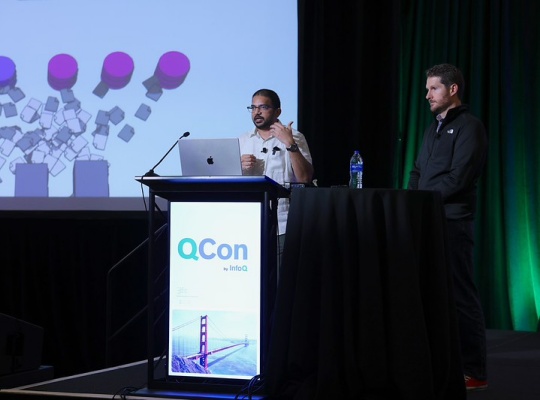
Raj Ummadisetty and Ken Kurzweil share Netflix's architectural pivot to CloudStream, a repeatable capture, conversion, and deployment framework. They discuss shifting key-value abstractions from stateless to stateful to move terabytes of bulk data safely. Software architects will learn to exploit data access patterns, use "Pathfinder" prototypes, and maintain a 99% faster rollout. By Rajasekhar Ummadisetty, Ken Kurzweil
Netflix is facing increasing data and AI/ML demands, requiring more efficient, real-time data processing and deployment frameworks to maintain its competitive edge in content delivery and recommendation.
This move by Netflix shows a significant industry trend towards complex data infrastructure for scaling AI/ML applications, indicating where leading companies are investing their architectural efforts.
Data architecture best practices are shifting towards highly automated, 'offline-to-online' frameworks for managing terabytes of critical data, emphasizing repeatability and rapid rollout for enterprise AI/ML initiatives.
- · Companies with advanced data engineering capabilities
- · Cloud infrastructure providers
- · AI/ML-centric enterprises
- · Data platform architects
- · Legacy data infrastructure providers
- · Organizations slow to adopt modern data pipelines
- · Manual data deployment practices
Netflix will experience improved efficiency and speed in deploying data-intensive features and AI models.
This methodology will be co-opted by other data-heavy enterprises, setting a new standard for operationalizing AI/ML development.
The increased agility in data deployment could accelerate the development and impact of AI agents requiring vast, frequently updated datasets.
This signal links to a primary source. Continuum Brief monitors and indexes it as part of the live intelligence stream — we do not republish source content.
Read at InfoQ