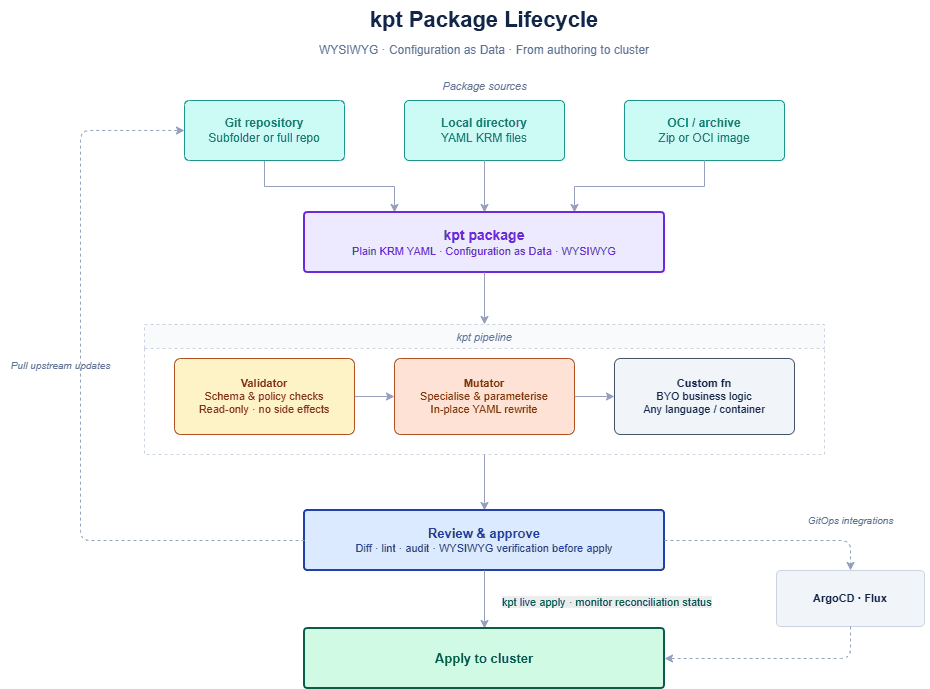
What is kpt? The opening tagline of the kpt documentation describes it as “… a package-centric toolchain that enables a WYSIWYG configuration authoring, automation, and delivery experience, which simplifies managing Kubernetes platforms and KRM-driven infrastructure at...
The re-introduction of kpt by the Cloud Native Computing Foundation reflects the ongoing industry demand for streamlined, automated infrastructure management solutions, particularly in increasingly complex Kubernetes environments.
This development is important for strategic readers as it signifies continued efforts to abstract infrastructure complexity, enabling faster deployment and more robust management of cloud-native applications, which underpins most modern digital infrastructure.
The focus on a package-centric toolchain for configuration authoring, automation, and delivery simplifies infrastructure-as-code practices, making Kubernetes and KRM-driven infrastructure more accessible and manageable for a broader audience.
- · Cloud Native Computing Foundation
- · Kubernetes adopters
- · Developers
- · Infrastructure operators
- · Traditional configuration management tools
- · Manual infrastructure scripting
Increased adoption of automated configuration management within Kubernetes ecosystems.
Reduced operational overhead for managing large-scale cloud-native deployments, freeing resources for innovation.
Further acceleration of cloud-native development cycles, potentially lowering barriers for entry to advanced infrastructure.
This signal links to a primary source. Continuum Brief monitors and indexes it as part of the live intelligence stream — we do not republish source content.
Read at Cloud Native Computing Foundation