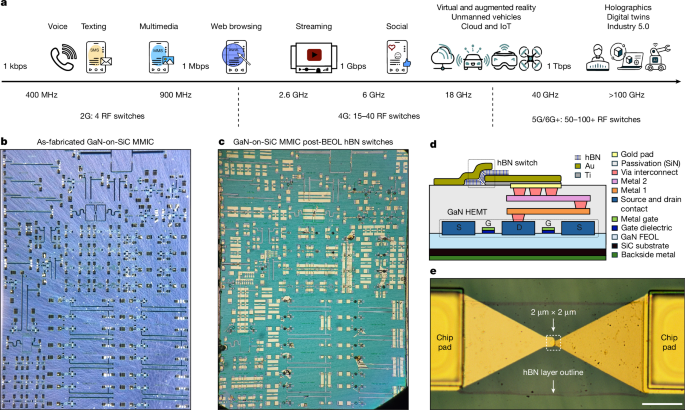
Nature, Published online: 08 July 2026; doi:10.1038/s41586-026-10761-8 Radio-frequency switches made from two-dimensional layered hexagonal boron nitride (hBN) were co-integrated on gallium nitride (GaN) microchips to build programmable millimetre-wave (mmWave) monolithic microwave integrated circuits suitable for 6G hardware.
Advances in materials science and semiconductor integration techniques have enabled the co-integration of novel 2D materials like hBN with established platforms like GaN, critical for next-generation wireless communications.
This development represents a significant step towards enabling the hardware for 6G wireless communication, offering reconfigurable and more efficient millimeter-wave microchips. It underpins the infrastructure requirements for future high-bandwidth applications.
The ability to produce reconfigurable mmWave microchips using hBN on GaN allows for more versatile and efficient radio-frequency components, potentially lowering power consumption and increasing data rates for future wireless systems.
- · Telecommunications equipment manufacturers
- · Semiconductor foundries
- · 6G infrastructure providers
- · Wireless device manufacturers
- · Manufacturers of less efficient RF switches
- · Legacy 5G hardware providers
Improved performance and decreased power consumption of future wireless communication devices.
Accelerated development and rollout of 6G networks, enabling new applications reliant on ultra-high bandwidth and low latency.
Enhanced capabilities for edge computing and real-time AI processing due to rapid, ubiquitous data transfer, potentially impacting various sectors like autonomous vehicles and industrial IoT.
This signal links to a primary source. Continuum Brief monitors and indexes it as part of the live intelligence stream — we do not republish source content.
Read at Nature — Latest Research