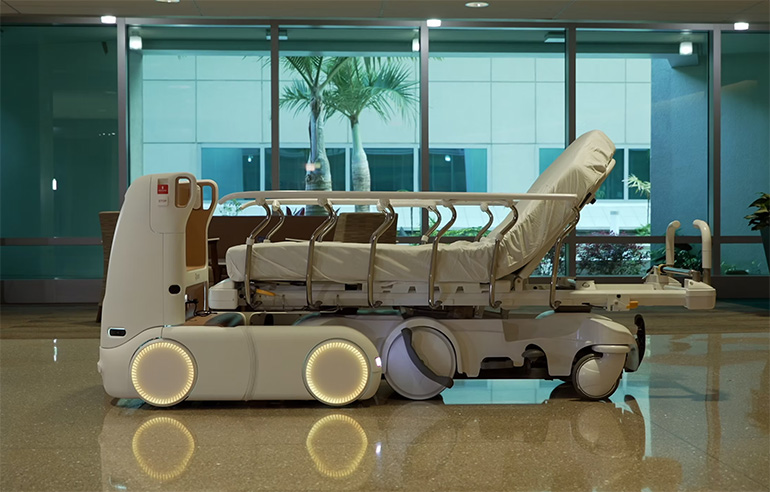
Patient mobility in hospital settings is ripe for automation, with Rovex and Sphaira among the innovators taking different approaches. The post Rovex and Sphaira pioneer autonomous patient transport appeared first on The Robot Report .
Automation in healthcare, particularly in logistics and patient transport, is a growing area as hospitals seek efficiency gains and solutions to labor shortages.
The development and deployment of autonomous robots for patient transport indicate an acceleration in healthcare automation, impacting operational models and staffing.
Hospitals are starting to adopt autonomous solutions for roles traditionally performed by human staff, shifting labor requirements and potentially improving patient flow.
- · Healthcare robotics companies
- · Hospitals adopting automation
- · Patients with improved transport efficiency
- · Manual patient transport service providers
- · Healthcare labor unions
- · Traditional hospital logistics providers
Hospitals will likely see immediate improvements in internal logistics efficiency and potentially reduced operational costs.
The successful implementation of autonomous patient transport could lead to broader adoption of robotics in clinical support roles.
Increased reliance on autonomous systems might necessitate new regulatory frameworks for patient safety and data privacy in healthcare robotics.
This signal links to a primary source. Continuum Brief monitors and indexes it as part of the live intelligence stream — we do not republish source content.
Read at The Robot Report