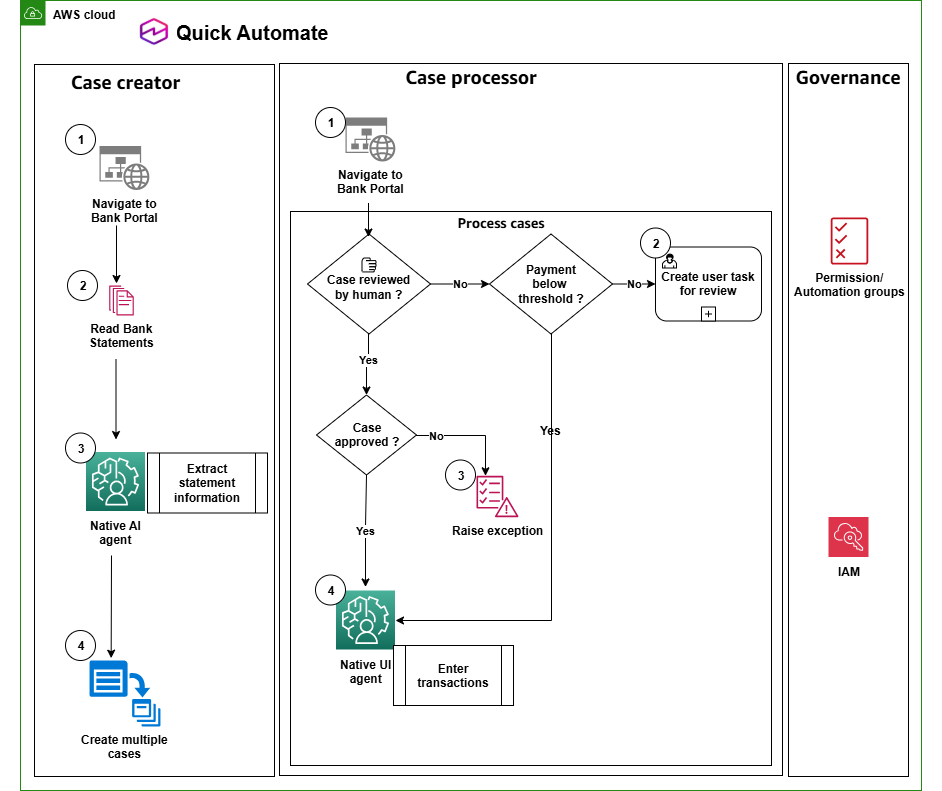
In this post, we show you how to combine case management with agentic automation capabilities in Quick Automate. We introduce case management and explore the lifecycle of cases in an agentic workflow from case creation through processing to resolution. We cover how to create and manage single or multiple cases, automatically track and update status, handle exceptions, and incorporate Human-in-the-loop (HITL) steps within workflows. We also show the case creator-processor pattern that enables dynamic scaling. Finally, we walk through how to structure case management for enterprise processes, in
The release of Quick Automate with native case management reflects the increasing maturity and practical application of AI agents in enterprise workflows, moving beyond theoretical concepts to integrated solutions.
This development signals a significant step towards autonomous agentic systems collapsing white-collar workflows, enabling dynamic scaling and reducing the need for direct human intervention in many processes.
Enterprise processes can now integrate AI agents with structured case management, allowing for automated tracking, exception handling, and human-in-the-loop integration, fundamentally altering how tasks are managed and executed.
- · AWS
- · Enterprises adopting agentic workflows
- · AI software developers
- · Automation solution providers
- · Manual workflow managers
- · Legacy business process outsourcing (BPO)
- · Companies slow to adopt automation
Increased efficiency and cost savings for businesses that implement Quick Automate with agentic workflows.
A broader societal shift towards redefining human roles in white-collar jobs as agents handle more complex tasks, leading to upskilling requirements or job displacement.
The acceleration of AI development and adoption as successful enterprise applications drive further investment and innovation in agentic systems.
This signal links to a primary source. Continuum Brief monitors and indexes it as part of the live intelligence stream — we do not republish source content.
Read at AWS Machine Learning Blog