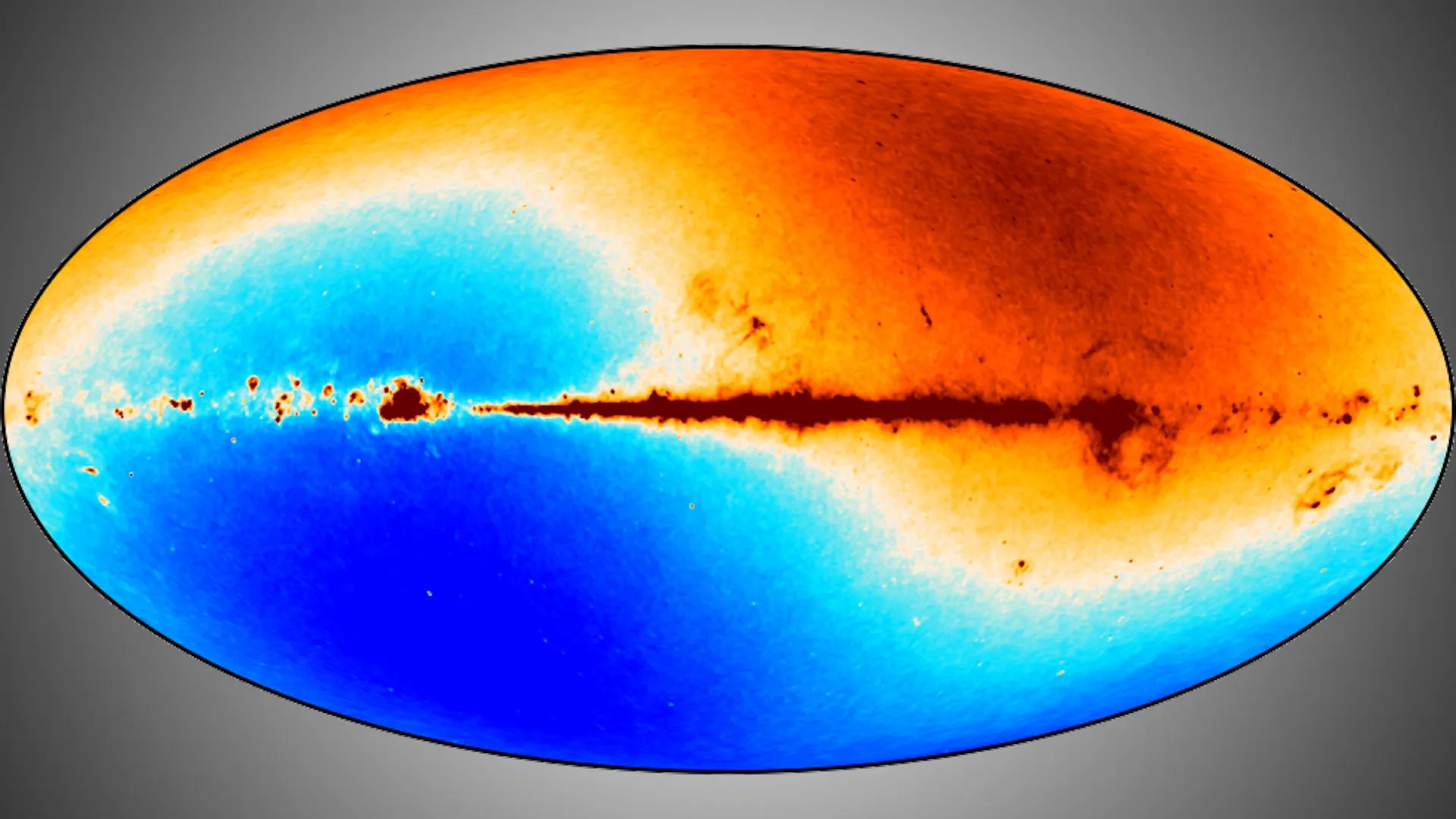
What if one of the biggest assumptions in cosmology is wrong? New research suggests the universe may not be perfectly uniform in every direction, as scientists have long believed. A puzzling mismatch known as the cosmic dipole anomaly shows that the distribution of distant galaxies and quasars doesn’t align with patterns seen in the leftover glow of the Big Bang. If confirmed, this discrepancy could undermine the foundation of the standard model of cosmology and force researchers to rethink how the universe is structured from the ground up.
New scientific evidence published by ScienceDaily's Robotics section on July 7, 2026, presents a significant challenge to a fundamental assumption in cosmology.
A potential refutation of the universe's uniformity could fundamentally alter our understanding of cosmic structure, impacting long-held scientific models and future research directions.
The prior assumption of a perfectly uniform universe is now under scrutiny, potentially requiring a complete reassessment of the standard model of cosmology.
- · Theoretical physicists
- · Astrophysicists
- · Cosmological research institutions
- · Proponents of the standard cosmological model
- · Cosmological theories based on uniform distribution
Scientific discourse will intensely focus on validating or refuting the cosmic dipole anomaly.
New observational missions and theoretical frameworks will emerge to explore the implications of a non-uniform universe.
Long-term philosophical and existential interpretations of humanity's place in the universe could be reshaped.
This signal links to a primary source. Continuum Brief monitors and indexes it as part of the live intelligence stream — we do not republish source content.
Read at ScienceDaily — Robotics