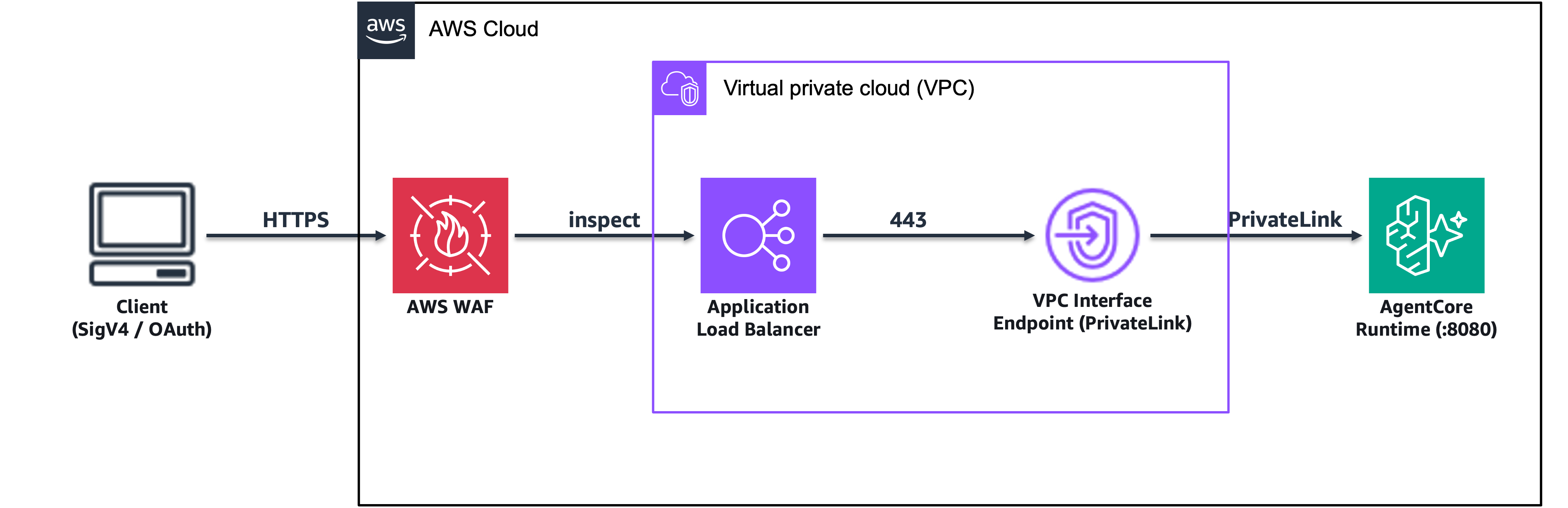
This post shows you two architecture patterns that address this problem. Both use an internet-facing ALB with AWS WAF and route traffic through a VPC Interface Endpoint to AgentCore Runtime. Pattern 1 places an AWS Lambda proxy between the ALB and the VPC Endpoint, giving you full control over request transformation. Pattern 2 targets the VPC Endpoint ENI IP addresses directly from the ALB, removing the Lambda hop entirely. You also learn how to close the direct-access backdoor with a resource policy so that traffic flows through AWS WAF only. Both patterns have been tested end-to-end with Sig
The increasing adoption of AI agents necessitates robust security solutions, particularly as these systems handle sensitive data and processes.
Securing AI agent runtimes prevents unauthorized access, data breaches, and manipulation, which is crucial for enterprise adoption and trust in AI systems.
This post provides architectural patterns that enhance the security posture of AI agent deployments, making them more resilient to external threats.
- · AWS customers implementing AI agents
- · Cybersecurity solution providers
- · Organizations requiring high-security AI deployments
- · Malicious actors targeting AI agent runtimes
- · Organizations with unsecure AI agent deployments
Improved security for AWS Bedrock AgentCore runtime environments.
Increased enterprise confidence in deploying AI agents for critical business functions.
Reduced risk of AI agent-centric cyberattacks becoming a significant vector.
This signal links to a primary source. Continuum Brief monitors and indexes it as part of the live intelligence stream — we do not republish source content.
Read at AWS Machine Learning Blog