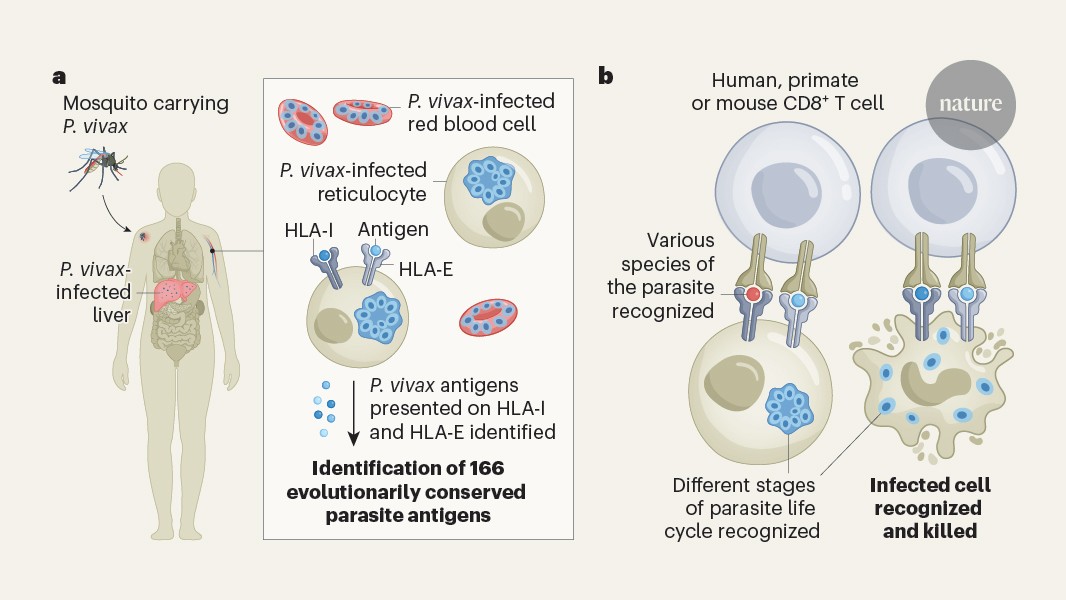
Nature, Published online: 01 July 2026; doi:10.1038/d41586-026-01808-x Evolutionarily conserved targets have been identified that are shared across malaria-parasite species and their life stages and are recognized by the human immune system.
Advances in genomic sequencing and immunological research are enabling the identification of broadly effective vaccine targets, moving from species-specific to universal approaches.
A universal malaria vaccine would represent a significant public health breakthrough, reducing disease burden, healthcare costs, and improving economic stability in endemic regions.
The focus for malaria vaccine development shifts from individual parasite strains to conserved, cross-species targets, offering the potential for more enduring and widespread immunity.
- · Vaccine developers
- · Global health organizations
- · Populations in malaria-endemic regions
- · Pharmaceuticals
Accelerated development of a highly effective malaria vaccine.
Significant reduction in malaria morbidity and mortality, freeing up healthcare resources and boosting productivity in affected nations.
Potential for a 'blueprint' approach to identifying universal targets for other complex parasitic diseases, redefining vaccine development paradigms.
This signal links to a primary source. Continuum Brief monitors and indexes it as part of the live intelligence stream — we do not republish source content.
Read at Nature — Latest Research