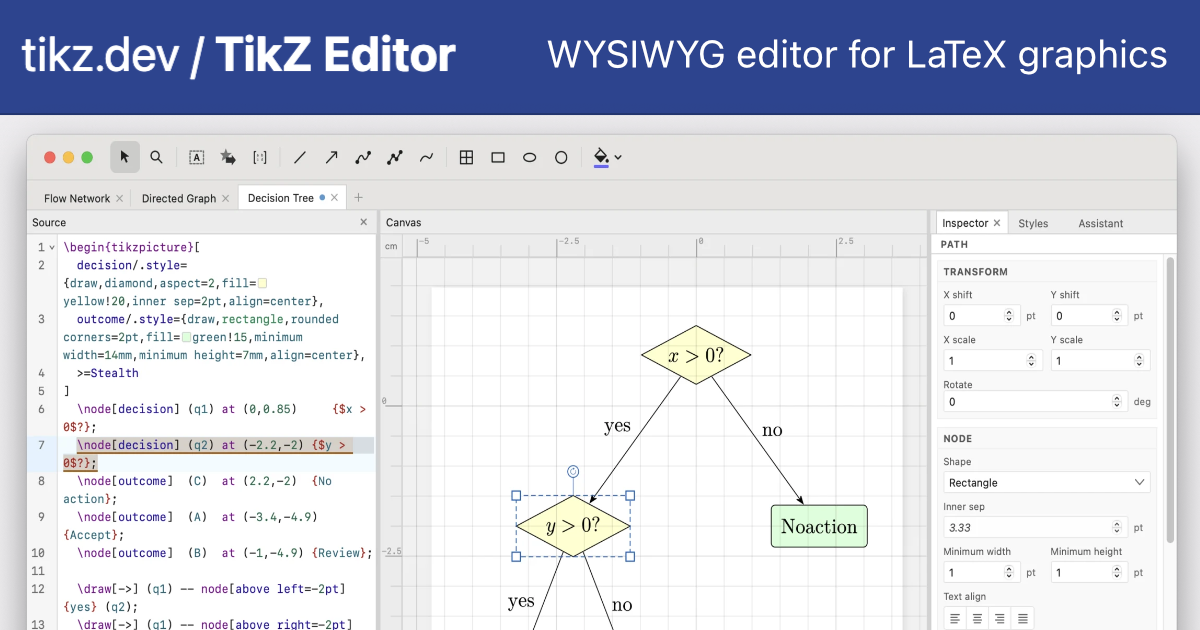
Hi all! TikZ is a widely-used LaTeX package for drawing figures in papers. It uses commands like \draw[->] (0,0) -- (1,2); to draw lines, shapes, text, etc. Academics usually code up their figures by hand, so there is lots of twiddling around with the coordinates and recompiling until things look nice. I guess it’s a bit like SVG, but it’s more code than markup, for example it has loops with \foreach. I built an open-source WYSIWYG TikZ editor (available for web and desktop) that allows you to edit your TikZ source code visually by dragging and resizing elements. It simultaneously shows the so
The continuous drive for more intuitive and visual tools in programming and technical documentation highlights the ongoing friction in code-centric figure generation.
This development represents a small but tangible improvement in the workflow for researchers and technical professionals, reducing time spent on tedious figure generation.
Academics and engineers using LaTeX can now create and modify complex diagrams more efficiently, potentially improving publishing speed and visual clarity in technical documents.
- · Academics
- · Technical communicators
- · LaTeX users
- · Open-source software developers
- · Users resistant to new tools
- · Manual TikZ editing workflows
Increased efficiency in creating technical illustrations for academic papers and presentations will be observed.
The accessibility of TikZ diagrams may lead to their more widespread adoption over other figure generation tools in certain academic fields.
The success of this tool could inspire similar WYSIWYG interfaces for other complex code-based documentation or graphics systems, fostering a broader trend towards visual programming in specific niches.
This signal links to a primary source. Continuum Brief monitors and indexes it as part of the live intelligence stream — we do not republish source content.
Read at Hacker News — Front Page