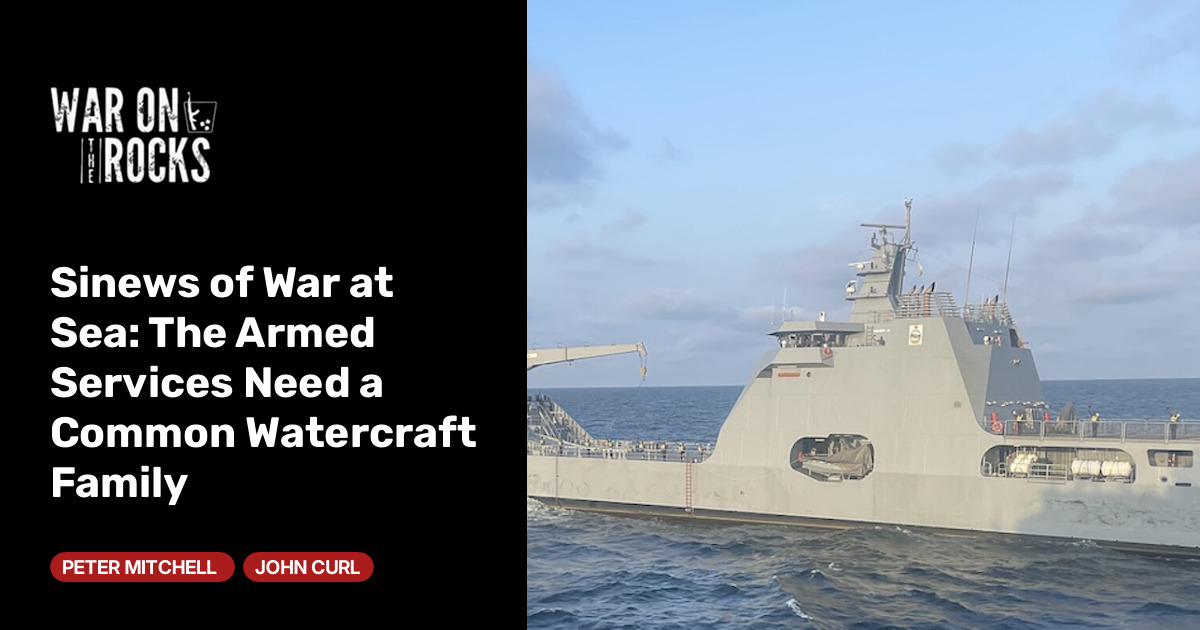
To sustain future maritime operations, the U.S military will need to run supplies through an environment that spans thousands of miles of open ocean, denied ports, contested straits, and archipelagic chokepoints against adversaries that have spent decades studying how to target American logistics. That problem does not require one identical vessel for every mission. It does require a more common family of watercraft for the manned ships that carry cargo and vehicles inside a theater, built for scale, interoperability, and wartime replacement. Getting this right is arguably the most important a
The US military is recognizing the urgent need to adapt its logistics and supply chain capabilities to counter advanced anti-access/area denial strategies, particularly from adversaries like China in the Indo-Pacific.
A more common family of watercraft signifies a strategic pivot towards agile, scalable, and resilient maritime logistics essential for sustaining operations in contested environments.
The shift implies a standardized approach to vessel design and procurement focused on interoperability, ease of replacement, and mass production, moving away from bespoke solutions for each service.
- · US Navy
- · Shipbuilding industry
- · Defense contractors focused on modularity
- · Manufacturers of highly specialized, single-purpose vessels
Increased focus on shared logistics platforms across US armed services.
Reduced operational costs and improved supply chain resilience for forward-deployed forces.
Enhanced overall deterrent posture by demonstrating robust logistical sustainment capabilities in projected conflict zones.
This signal links to a primary source. Continuum Brief monitors and indexes it as part of the live intelligence stream — we do not republish source content.
Read at War on the Rocks