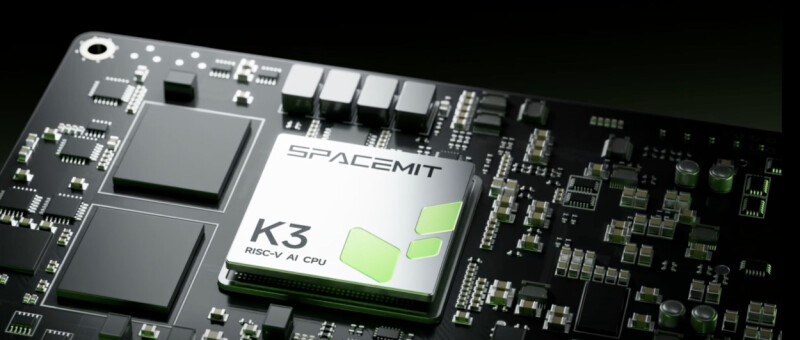
Actual RVA23 hardware and useful performance – for a certain price
The RVA23 RISC-V specification is maturing, allowing for the development of commercially viable hardware that challenges established architectures. Increasing geopolitical tensions are accelerating interest in non-US controlled silicon.
This marks a tangible step towards RISC-V becoming a viable alternative to x86 and ARM in certain market segments, potentially decentralizing the compute supply chain. It provides a proof point that RISC-V can deliver 'usable-quick' performance outside of embedded systems.
Hardware vendors now have a demonstrable example of a performance-oriented RISC-V desktop, which could spur further investment and development in the ecosystem. This product could serve as a beachhead for RISC-V in a market currently dominated by x86.
- · RISC-V ecosystem
- · SpacemiT
- · Open-source hardware developers
- · Governments seeking tech independence
- · Intel (x86 dominance)
- · AMD (x86 dominance)
- · ARM Holdings (potential future competition)
This successful product launch validates the RVA23 standard and accelerates competitor efforts in RISC-V desktop solutions.
Increased adoption of RISC-V desktops could lead to a broader software ecosystem developing for the architecture, further solidifying its position.
Long-term, this could contribute to the fragmentation of the PC processor market, reducing reliance on a few dominant players and enabling new regional tech champions.
This signal links to a primary source. Continuum Brief monitors and indexes it as part of the live intelligence stream — we do not republish source content.
Read at The Register