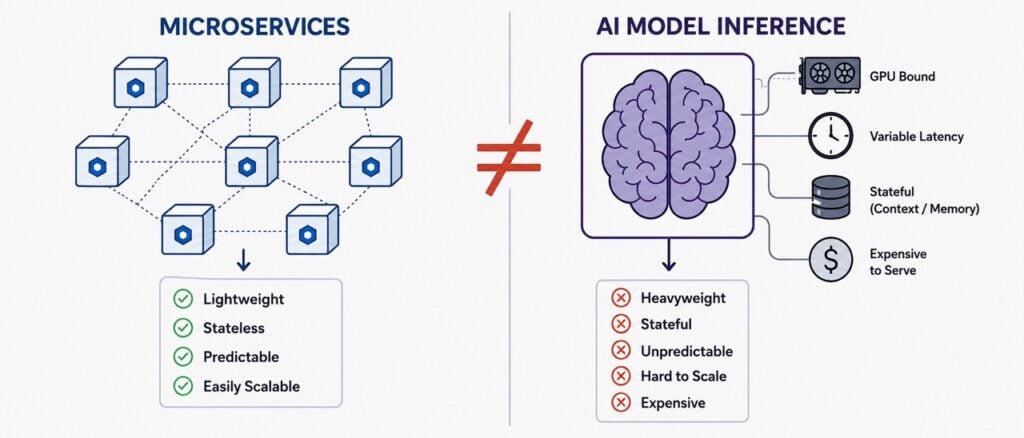
A few years ago, it felt like Kubernetes had become the universal answer to infrastructure problems. Teams wanted resiliency? Kubernetes. Faster deployments? Kubernetes. Scalability? Kubernetes again. Eventually, the industry stopped treating cloud-native architecture as a design choice and started treating it almost like a law of physics. For traditional software The post Stop Treating Your Models Like Microservices appeared first on Cloud Native Now .
The proliferation of AI models, distinct from traditional microservices in their operational and architectural demands, necessitates a re-evaluation of established cloud-native patterns like Kubernetes.
Blindly applying existing infrastructure paradigms to AI models leads to inefficiencies, increased costs, and hinders the scalability and performance required for next-generation AI applications.
The best practices for deploying and managing AI models will diverge significantly from those for general-purpose applications, leading to specialized tooling and architectural patterns for machine learning operations (MLOps).
- · Specialized MLOps platforms
- · Cloud providers with AI-optimized infrastructure
- · Companies focused on AI model efficiency
- · Generic cloud-native platforms without AI specialization
- · Companies with rigid architectural approaches
- · Teams treating AI models as black boxes
Increased investment in bespoke infrastructure and tooling designed explicitly for AI model serving and management.
A potential fracturing of the 'cloud-native' ecosystem into distinct sub-ecosystems optimized for different workloads like AI.
New certification programs and skill sets emerging around MLOps and AI-specific infrastructure, creating a talent gap for traditional DevOps engineers.
This signal links to a primary source. Continuum Brief monitors and indexes it as part of the live intelligence stream — we do not republish source content.
Read at Container Journal