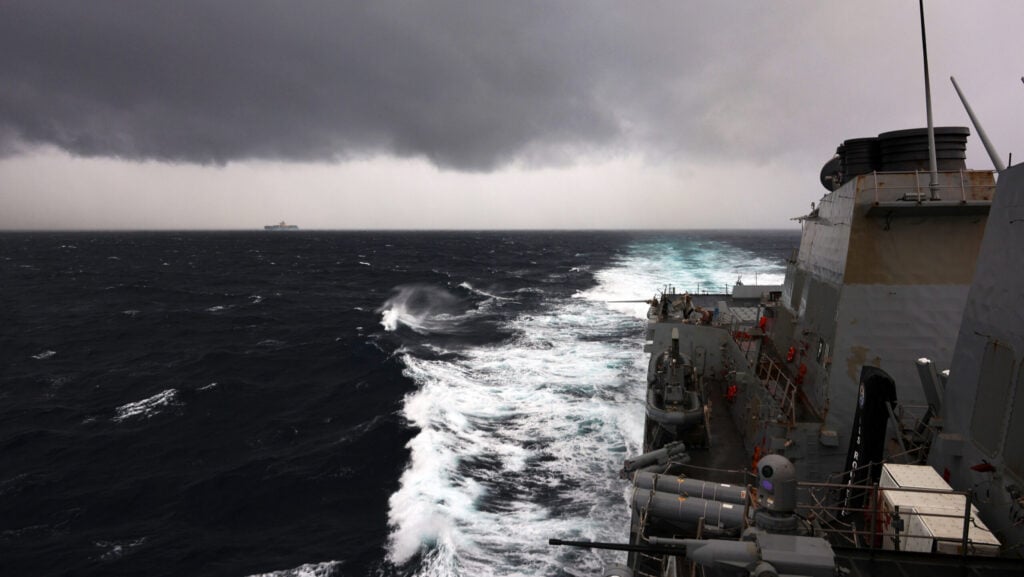
President Donald Trump had floated the idea of a naval escort months ago, but Adm. Daryl Caudle said today it would be a “very challenging mission.”
The statement from the CNO directly challenges a previous presidential suggestion, highlighting current military capacity constraints in a critical geopolitical choke point.
A strategic reader should care because it reveals the operational limits of a major naval power, impacting geopolitical strategy and alliances in a volatile region.
The perceived ability of the US Navy to unilaterally manage security in key maritime passages is now openly questioned by its own leadership, necessitating a re-evaluation of force projection and potential burden-sharing.
- · Naval technology and automation companies
- · Allied navies capable of burden-sharing
- · Powers seeking regional influence without US intervention
- · US Navy (in terms of perceived operational flexibility)
- · Shipping companies reliant on guaranteed escorts
- · US presidential administrations seeking easy military solutions
Increased pressure on the US Navy to invest in recapitalization and advanced capabilities to meet global demands.
Potential for increased instability in critical maritime trade routes if effective substitute security measures are not implemented.
Accelerated development and adoption of autonomous naval systems and drones to augment human-crewed fleets.
This signal links to a primary source. Continuum Brief monitors and indexes it as part of the live intelligence stream — we do not republish source content.
Read at Breaking Defense