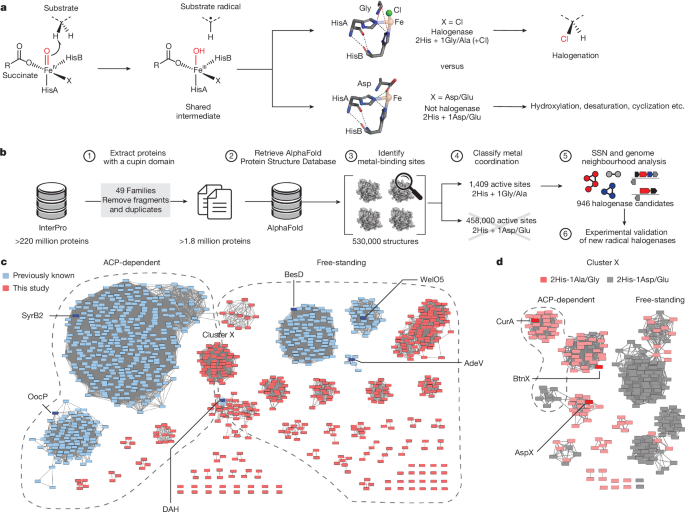
Nature, Published online: 01 July 2026; doi:10.1038/s41586-026-10716-z A methodology for mining protein structure databases on the basis of the distinct intrinsic structures of metal-binding active sites in enzymes enables the discovery of new families of radical halogenases.
Rapid advancements in computational biology and protein structure prediction are enabling more sophisticated approaches to enzyme discovery, making this kind of targeted mining feasible now.
This breakthrough represents a significant leap in the ability to design and discover novel enzymes, which are critical for biotechnological applications across multiple industries.
The methodology for enzyme discovery shifts from high-throughput screening to targeted, structure-based mining, significantly accelerating the identification of new functional proteins.
- · Biotechnology sector
- · Pharmaceutical companies
- · Industrial enzyme producers
- · Synthetic biology researchers
- · Companies relying on traditional enzyme discovery methods
- · Costly, untargeted screening approaches
New families of radical halogenases become available for research and commercial applications.
Accelerated development of novel biocatalysts for industrial processes, drug synthesis, and agricultural applications.
The ability to 'program' biological systems with bespoke enzymatic functions becomes much more accessible, leading to a new era of bio-manufacturing.
This signal links to a primary source. Continuum Brief monitors and indexes it as part of the live intelligence stream — we do not republish source content.
Read at Nature — Latest Research