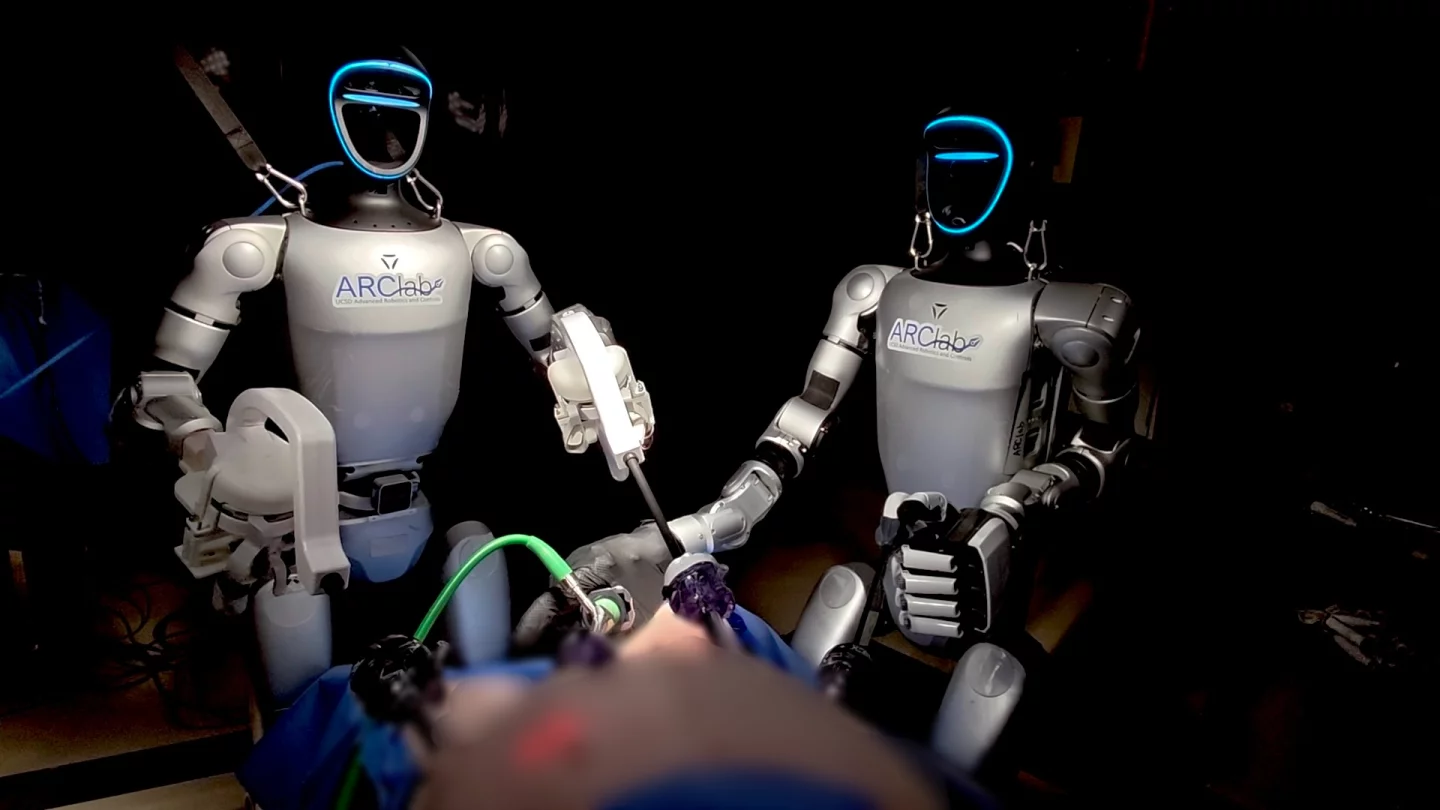
Surgeons at UC San Diego just handed the scalpel to two humanoid robots, who went on to complete live surgical procedures for the first time in history. This milestone moves beyond the fixed robotic arms found in operating rooms today and hints at an operating room of the future where humans and humanoids work side by side. Continue Reading Category: Robotics , Engineering Tags: Robots , Humanoid , Surgical robot , Surgery , Tele-operation , UC San Diego
Advances in robotics, AI, and teleoperation technology have matured to enable complex, real-time control of humanoid platforms in sensitive environments like surgery.
This event marks a significant step towards human-robot collaboration in highly skilled professions, demonstrating robot capabilities beyond fixed automation and hinting at future workforce implications.
The perceived boundary of tasks achievable by humanoid robots has expanded to include live surgical procedures, moving beyond theoretical discussions to practical application in a regulated field.
- · Robotics companies
- · Healthcare providers
- · Surgical instrument manufacturers
- · Teleoperation technology firms
- · None
Increased investment and research into advanced surgical robotics and humanoid development.
Expansion of teleoperated surgery to remote or underserved areas, improving access to specialized medical procedures.
Re-evaluation of medical training and roles, with a focus on human-robot team dynamics and oversight rather than purely manual skills.
This signal links to a primary source. Continuum Brief monitors and indexes it as part of the live intelligence stream — we do not republish source content.
Read at New Atlas — Robotics