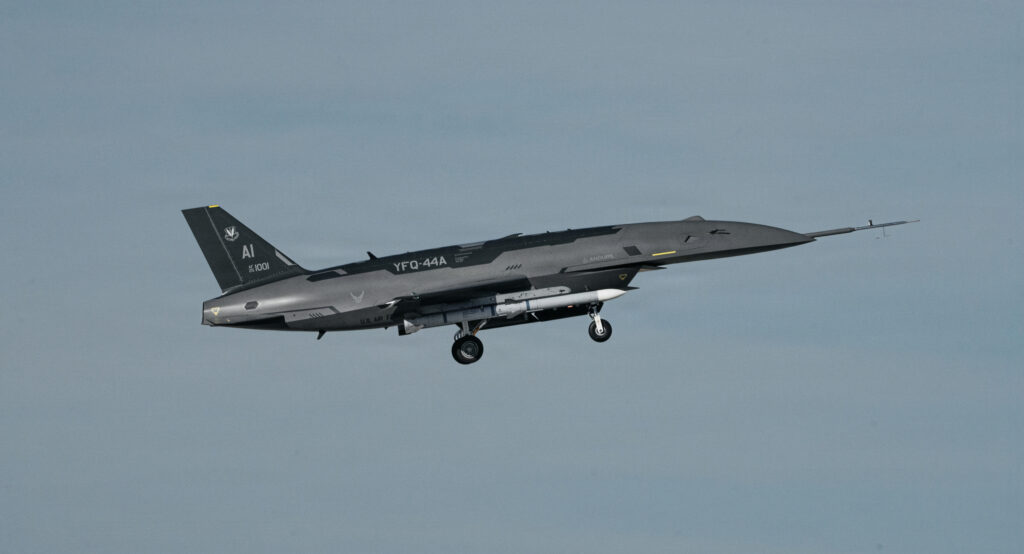
While services test teaming with Collaborative Combat Aircraft, industry faces hard questions.
The US Air Force is actively developing and testing Collaborative Combat Aircraft concepts, prompting industry to rapidly innovate and adapt to emerging specifications and operational demands.
This development highlights the accelerating shift towards autonomous and AI-driven combat systems, redefining future air warfare strategies and defense industrial requirements.
The focus is moving beyond initial assumptions for CCA design, indicating a more complex and adaptive development pathway driven by testing and technological evolution.
- · Defence Tech Companies
- · AI/Autonomy Developers
- · Aerospace Industry
- · Traditional manned aircraft manufacturers
- · Companies slow to adapt to AI/autonomy
Rapid prototyping and iterative design cycles for autonomous combat aircraft will become the norm.
New doctrines and training regimes for human-machine teaming in combat scenarios will be required.
The proliferation of advanced autonomous AI in warfare could lead to new geopolitical stability challenges and arms control discussions.
This signal links to a primary source. Continuum Brief monitors and indexes it as part of the live intelligence stream — we do not republish source content.
Read at Breaking Defense — Air