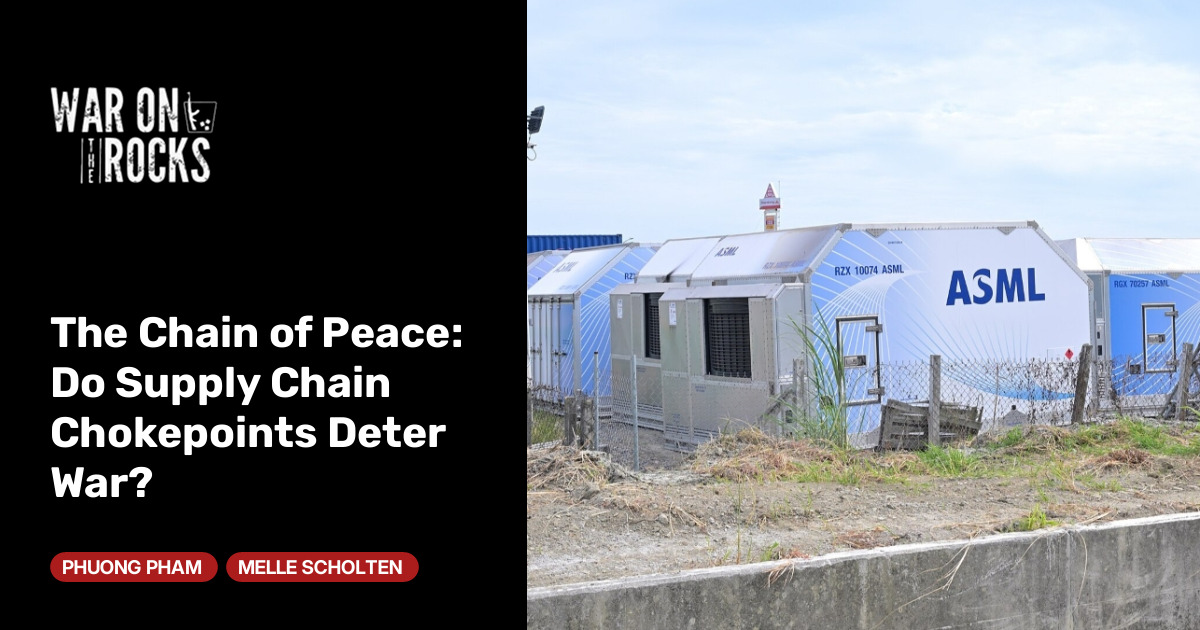
The next war over Taiwan may be deterred not by aircraft carriers or nuclear arsenals, but by a Dutch lithography machine. ASML, headquartered in Veldhoven, the Netherlands, is the sole manufacturer of the extreme ultraviolet lithography systems required to produce the world’s most advanced semiconductors. Without its machines, the most sophisticated foundries on earth — including those of the Taiwan Semiconductor Manufacturing Company (TSMC) — cannot operate. This fact should be at the center of how the United States thinks about deterrence in the Indo-Pacific. Currently, it is not.The conven
The article highlights an existing, underappreciated vulnerability in global semiconductor supply chains, pushing for its recognition as a key deterrence factor in rising Indo-Pacific tensions.
This re-frames deterrence away from traditional military might towards critical technological chokepoints, compelling strategic planners to consider economic statecraft and supply chain control as primary tools of geopolitical influence.
The understanding of what constitutes effective deterrence in potential conflicts, particularly regarding Taiwan, shifts from conventional military assets to control over sophisticated manufacturing inputs like lithography machines.
- · Netherlands
- · ASML
- · Nations controlling key tech chokepoints
- · Taiwan
- · China
- · US Military-centric deterrence strategists
The reliance on a single company's technology for advanced semiconductor production becomes a central point of geopolitical leverage.
Increased pressure on nations to diversify or onshore critical manufacturing capabilities to reduce vulnerability.
This could lead to a global 'lithography arms race' or strategic alliances focused on securing access to or control over such technologies.
This signal links to a primary source. Continuum Brief monitors and indexes it as part of the live intelligence stream — we do not republish source content.
Read at War on the Rocks