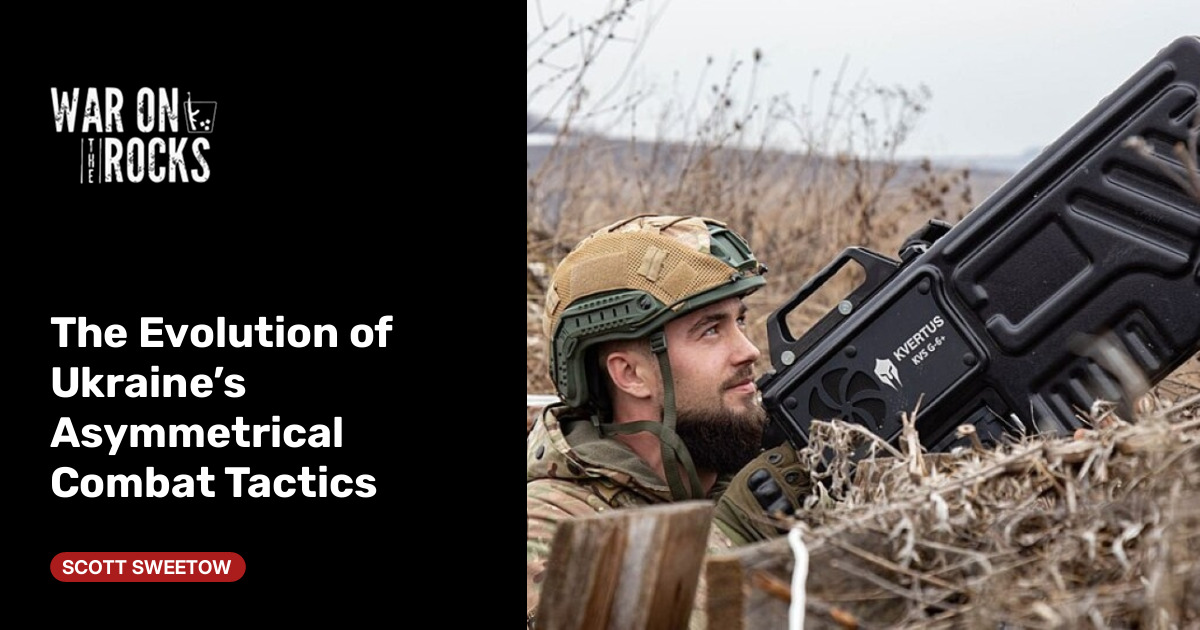
In 2022, Scott Sweetow wrote, “Of Roadside Bombs and Drones: Putin’s Looming Insurgency Problem,” where he argued Ukraine’s fight against Russia would rely on a combination of conventional and asymmetrical insurgent tactics. Four years of combat later, we asked Scott to revisit his arguments.Image: National Information Warfare Center PacificIn your 2022 article, you argued that Ukraine’s tech-driven resistance could rapidly evolve into an insurgency-style force. Four years in, how have those assessments held up? Could one argue that Ukraine today operates more like an insurgency in some respec
Four years into the conflict, this analysis revisits initial predictions about Ukraine's combat strategy, offering an updated assessment of how their 'tech-driven resistance' has evolved.
This article highlights the demonstrable success and evolution of asymmetrical warfare, particularly in integrating advanced technology, offering critical insights for future military doctrine and defence strategies.
The perception of Ukraine's operational model has shifted from purely conventional to a hybrid insurgency-style force, demonstrating the adaptability of modern conflict.
- · Ukraine's defence forces
- · Defence tech innovators
- · Asymmetrical warfare strategists
- · Traditional conventional military doctrines
- · Nations reliant on pure conventional superiority
Ukraine's continued effective resistance against a larger power showcases the viability of hybrid warfare models.
Other nations may significantly invest in and adopt similar asymmetrical, technology-driven defence strategies.
This could lead to a global re-evaluation of military budgets, training programs, and equipment procurement, favoring agile and dispersed capabilities over heavy conventional forces.
This signal links to a primary source. Continuum Brief monitors and indexes it as part of the live intelligence stream — we do not republish source content.
Read at War on the Rocks