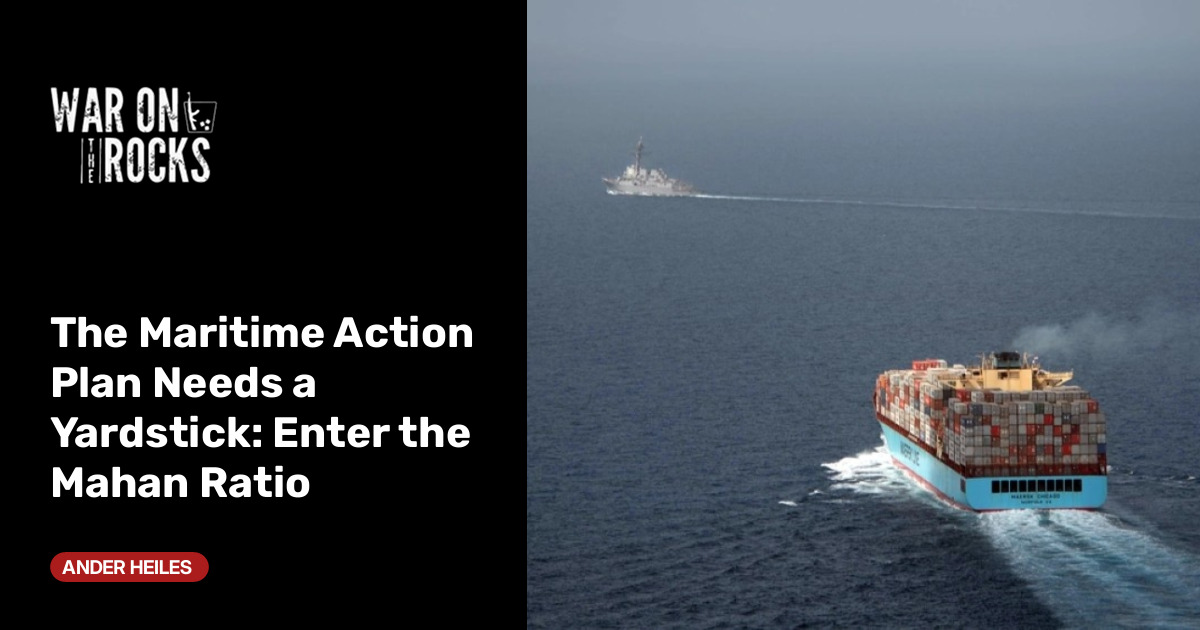
Washington is littered with the corpses of grand plans to restore the Merchant Marine. The Trump administration’s Maritime Action Plan is the latest attempt, and to its credit, the most comprehensive since World War II.The plan is the government’s blueprint to resurrect America’s commercial shipping and domestic shipbuilding industry. The goal is straightforward: build enough merchant ships and train enough civilian mariners to sustain the military through war, while cutting reliance on foreign supply chains in peace. With a $1.5 billion Maritime Security Trust Fund, Maritime Prosperity Zones,
The US is actively seeking to reduce reliance on foreign supply chains and bolster its military logistics capabilities after decades of decline in its commercial shipping.
A robust Merchant Marine and domestic shipbuilding industry are critical for national security, economic independence, and military projection during conflict, particularly in an era of U.S.-Chinese competition.
The explicit re-establishment of capacity metrics for the Merchant Marine signifies a tangible commitment to rebuild this strategic capability, moving beyond aspiration to measurable goals.
- · US shipbuilding industry
- · US Navy
- · Domestic logistics firms
- · US maritime unions
- · Foreign commercial shipping operators (for US military contracts)
- · Nations reliant on US reliance on their shipping capacity
- · US companies deeply integrated into foreign supply chains
Increased funding and policy focus on domestic maritime infrastructure and workforce development.
Potential for increased domestic manufacturing capacity and reduced reliance on global supply chains for critical goods.
Shift in geopolitical power dynamics as US strategic autonomy in logistics enables more aggressive and independent foreign policy postures.
This signal links to a primary source. Continuum Brief monitors and indexes it as part of the live intelligence stream — we do not republish source content.
Read at War on the Rocks