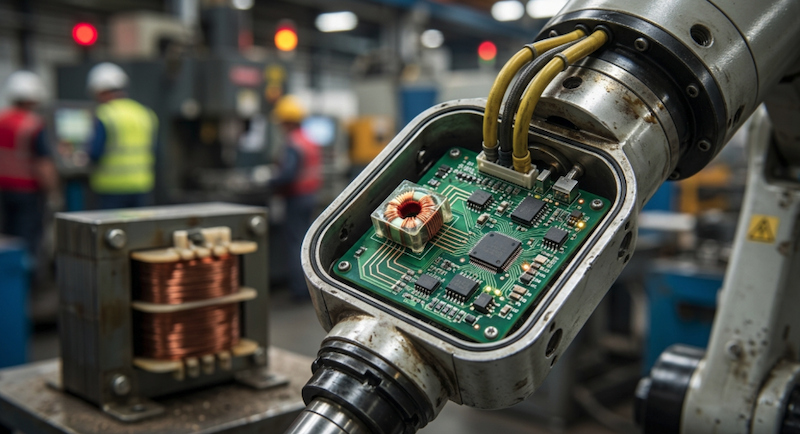
Picture an automotive assembly line or a high-speed semiconductor packaging facility. A robotic arm moves with sub-millimeter precision at three hundred cycles a minute, its movements coordinated by machine vision systems, remote I/O blocks, and sensitive microcontrollers. Everything draws power from a shared industrial rail. Then, a heavy CNC machine on the same grid fires […]
The increasing sophistication and density of industrial automation are highlighting the critical vulnerabilities of seemingly minor components under electrical stress.
Reliable industrial automation under complex electrical loads is essential for manufacturing stability, productivity, and the continued expansion of advanced robotics.
Focus is shifting towards more robust and resilient component design and integration within industrial power systems, rather than solely on robot mechanics or software.
- · Industrial component manufacturers
- · Automation system integrators
- · Advanced manufacturing sectors
- · Manufacturers relying on low-cost, less robust components
- · Facilities with unstable power grids
- · Legacy industrial equipment
Increased investment in resilient component design and power conditioning solutions for industrial environments.
Higher operational uptime and reduced maintenance costs for automated manufacturing facilities.
Accelerated adoption of advanced robotics in sectors previously constrained by reliability issues, potentially impacting labor allocation.
This signal links to a primary source. Continuum Brief monitors and indexes it as part of the live intelligence stream — we do not republish source content.
Read at Robotics & Automation News