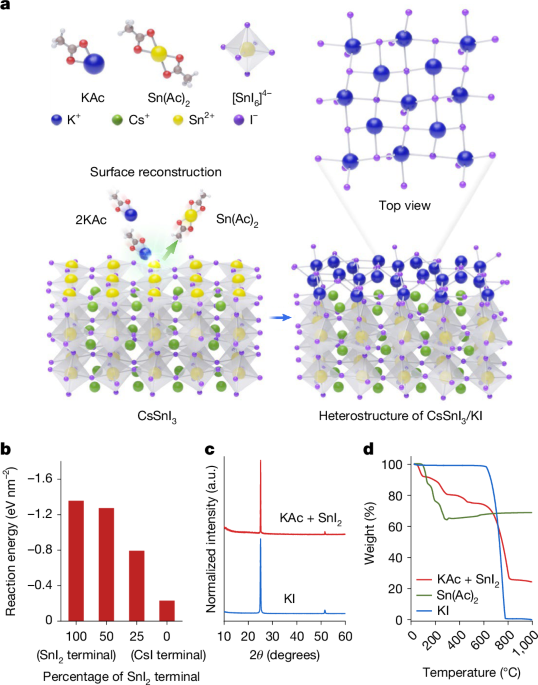
Nature, Published online: 01 July 2026; doi:10.1038/s41586-026-10714-1 A volatile-assisted coordination strategy regulates surface defect chemistry and self-doping, thus stabilizing the stoichiometry of tin perovskite semiconductors, resulting in transistors that can maintain stable operation for a month at temperatures of 100 °C.
Ongoing research into scalable, high-performance semiconductor materials is continuously yielding breakthroughs, and this specific advance addresses a key instability challenge in tin perovskites.
Tin perovskite transistors offer potential for high efficiency and low-cost manufacturing, making their stabilization crucial for next-generation electronics beyond traditional silicon.
This stabilization method directly addresses a major hurdle for tin perovskite materials, potentially enabling their widespread use in commercial applications operating at higher temperatures and for longer durations.
- · Quantum computing research
- · Electronics manufacturers
- · Material science companies
- · Semiconductor industry
- · Traditional silicon foundries (long term)
- · Less stable alternative semiconductor material developers
This advancement could accelerate the development of more efficient and sustainable electronic devices.
Reduced manufacturing costs for transistors could lower the barrier to entry for new hardware innovations.
Widespread adoption of these materials could reduce reliance on rare earth elements currently used in some electronics, impacting global supply chains.
This signal links to a primary source. Continuum Brief monitors and indexes it as part of the live intelligence stream — we do not republish source content.
Read at Nature — Latest Research