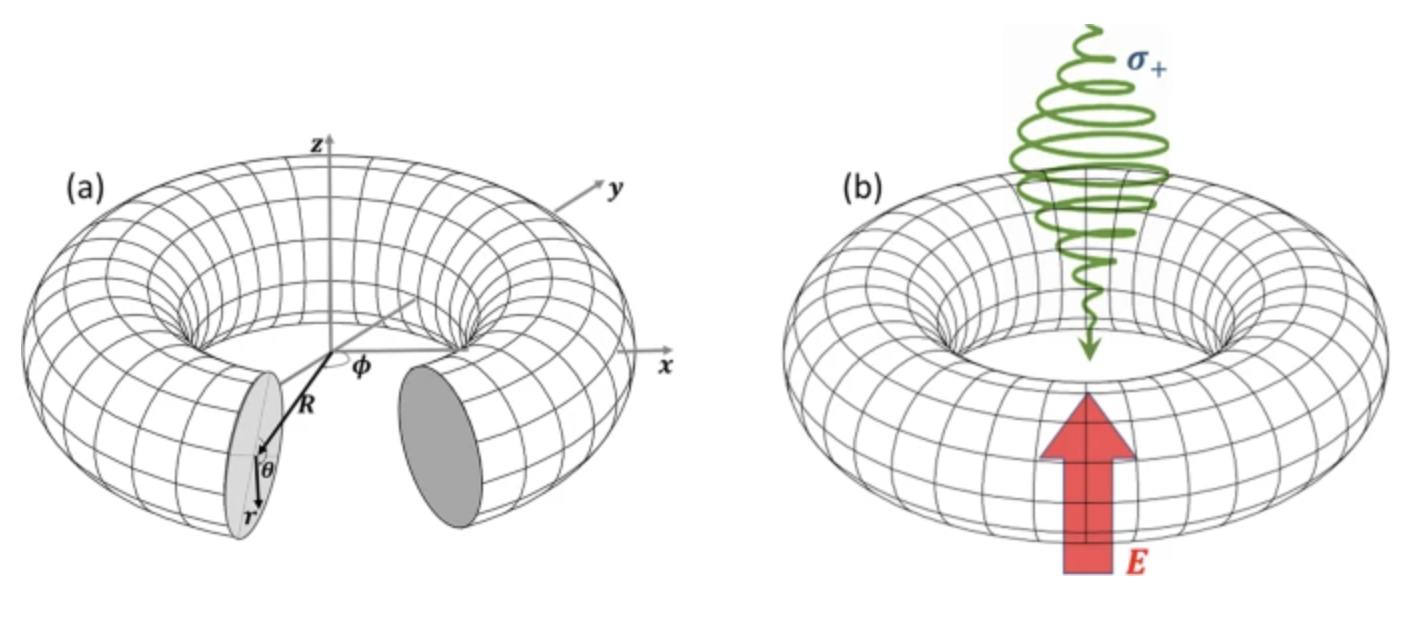
Insider Brief PRESS RELEASE — Quantum states can be precisely controlled with the help of tiny carbon rings measuring only a few nanometres in size. This is made possible by a class of rarely utilized electromagnetic dipoles called toroidal moments. Using computer simulations, physicists at Martin Luther University Halle-Wittenberg (MLU) have now found a way […]
Advances in materials science and computational simulations are enabling the theoretical exploration and practical manipulation of quantum states at increasingly smaller scales.
This research introduces a novel method for quantum control using toroidal moments, potentially unlocking new pathways for quantum computing and sensing with higher precision and stability.
The understanding and manipulation of quantum states are expanded beyond conventional electric and magnetic dipoles, offering a new tool for quantum technology development.
- · Quantum computing researchers
- · Materials science
- · Semiconductor industry
- · Quantum sensor developers
- · Classical computing paradigms (long-term decline)
- · Less advanced quantum research methods
Exploration of new quantum device architectures based on toroidal moments will accelerate.
Enhanced stability and coherence in quantum systems could lead to more robust quantum processors and sensors.
A fundamental shift in how quantum information is stored and processed, potentially enabling new fault-tolerant quantum computing approaches.
This signal links to a primary source. Continuum Brief monitors and indexes it as part of the live intelligence stream — we do not republish source content.
Read at The Quantum Insider