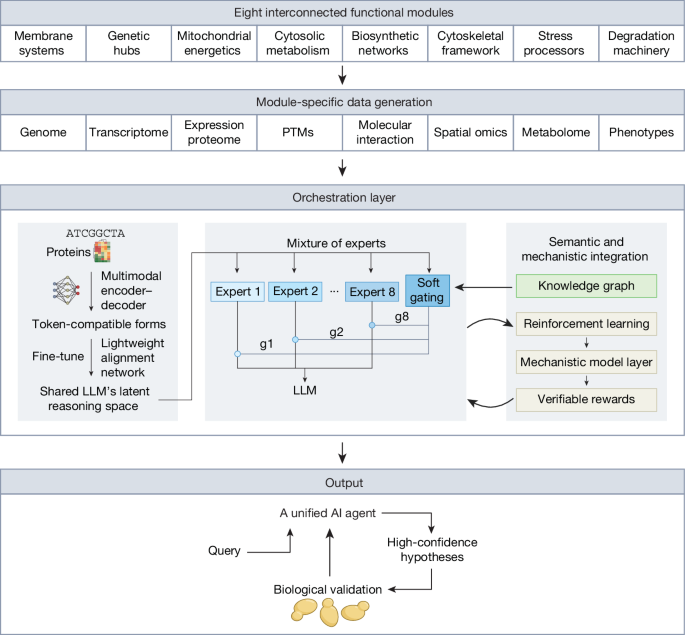
Nature, Published online: 01 July 2026; doi:10.1038/s41586-026-10574-9 A virtual yeast, an artificial intelligence-driven agent for modelling eukaryotic cellular behaviours, is described.
The convergence of advanced AI capabilities and synthetic biology research is enabling increasingly complex biological modeling and engineering.
This development pushes the boundaries of programmable biology, offering new capabilities for understanding and manipulating life at a foundational level.
The ability to virtually model eukaryotic cellular behaviors with AI could significantly accelerate drug discovery, bioengineering, and fundamental biological research.
- · Biotechnology sector
- · Pharmaceutical R&D
- · AI developers
- · Academic research institutions
- · Traditional wet lab methods (in some cases)
- · Companies reliant on slow, high-cost biological experimentation
Accelerated development of novel therapeutics and industrial biotechnologies.
Potential for designing entirely new biological systems with functions not found in nature.
Ethical and regulatory debates around the creation and implications of advanced synthetic life forms.
This signal links to a primary source. Continuum Brief monitors and indexes it as part of the live intelligence stream — we do not republish source content.
Read at Nature — Latest Research