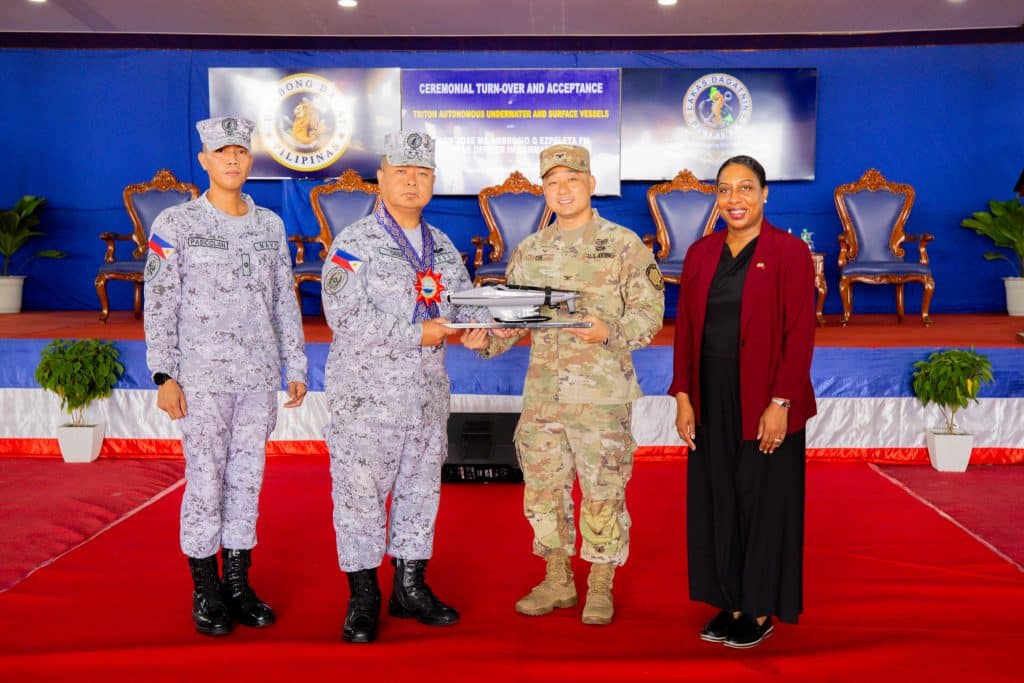
MANILA, Philippines — The Philippine Navy’s drone unit gained another system with the transfer of Ocean Aero Triton autonomous underwater and surface vehicles through a U.S.-funded initiative. Four Tritons were officially handed over to the Philippine Navy’s Unmanned Surface Vessel Unit One at Naval Operating Base Subic Bay on Monday. Powered by wind and solar ... The post U.S. Transfers Ocean Aero Tritons to Philippine Navy USV Unit appeared first on Naval News .
The US is actively strengthening alliances and enhancing partner capabilities in the Indo-Pacific, particularly with nations like the Philippines, to counter regional challenges.
This transfer signifies a clear trend towards integrating uncrewed systems into naval operations, enhancing intelligence, surveillance, and reconnaissance (ISR) capabilities for allied nations.
The Philippine Navy gains advanced autonomous maritime capabilities, reducing human risk in dangerous operations and extending its operational reach, while the US reinforces its position as a key security partner.
- · Philippine Navy
- · Ocean Aero
- · US Defense Industry
- · US Foreign Policy Objectives
- · Nations reliant on traditional manned reconnaissance
The Philippine Navy enhances its maritime domain awareness and operational effectiveness through autonomous capabilities.
Increased deployment of such USVs will likely lead to rapid advancements in autonomous maritime technology and operational doctrines across allied navies.
The proliferation of affordable and effective autonomous naval systems could alter the balance of power in contested maritime regions by enabling new forms of asymmetric warfare.
This signal links to a primary source. Continuum Brief monitors and indexes it as part of the live intelligence stream — we do not republish source content.
Read at Naval News