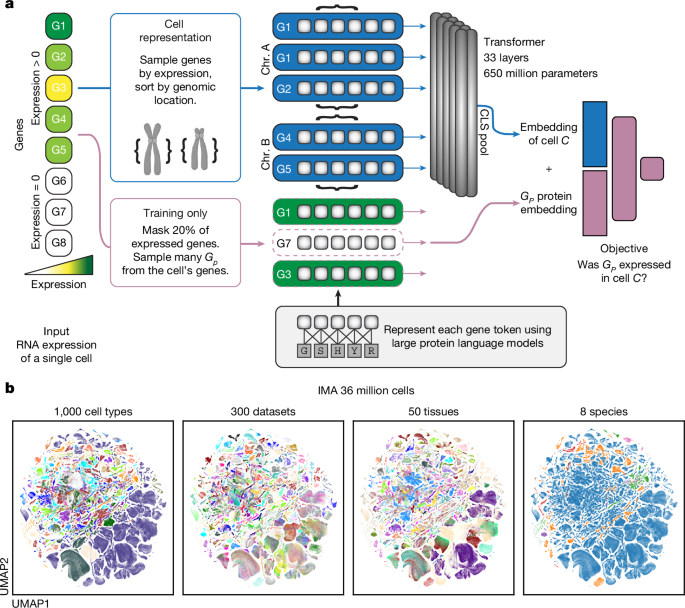
Nature, Published online: 08 July 2026; doi:10.1038/s41586-026-10689-z The universal cell embedding foundation model learns to capture the organization and variation of cells by training on 36 million cells from hundreds of experiments, dozens of tissues and eight species.
The development of a universal cell embedding foundation model signifies a maturation in computational biology, driven by advances in AI and the availability of large biological datasets.
This model provides a foundational tool for understanding cellular organization and variation across species, accelerating drug discovery, disease understanding, and biotechnological applications.
The ability to universally embed and analyze cellular data changes how researchers approach cell biology, enabling more systematic and comparative studies on an unprecedented scale.
- · Biotechnology companies
- · Pharmaceutical R&D
- · Academic research institutions
- · AI platform providers
- · Traditional wet lab biology research reliant solely on individual experiments
- · Companies with proprietary but segmented cellular datasets
Researchers gain a powerful, standardized lens for cellular analysis and prediction across diverse biological contexts.
The pace of discovery for novel drug targets and cellular therapies accelerates significantly due to AI-driven insights.
This could lead to a 'Google Maps' for cells, enabling predictive modeling of organismal health and disease progression at a cellular level.
This signal links to a primary source. Continuum Brief monitors and indexes it as part of the live intelligence stream — we do not republish source content.
Read at Nature — Latest Research