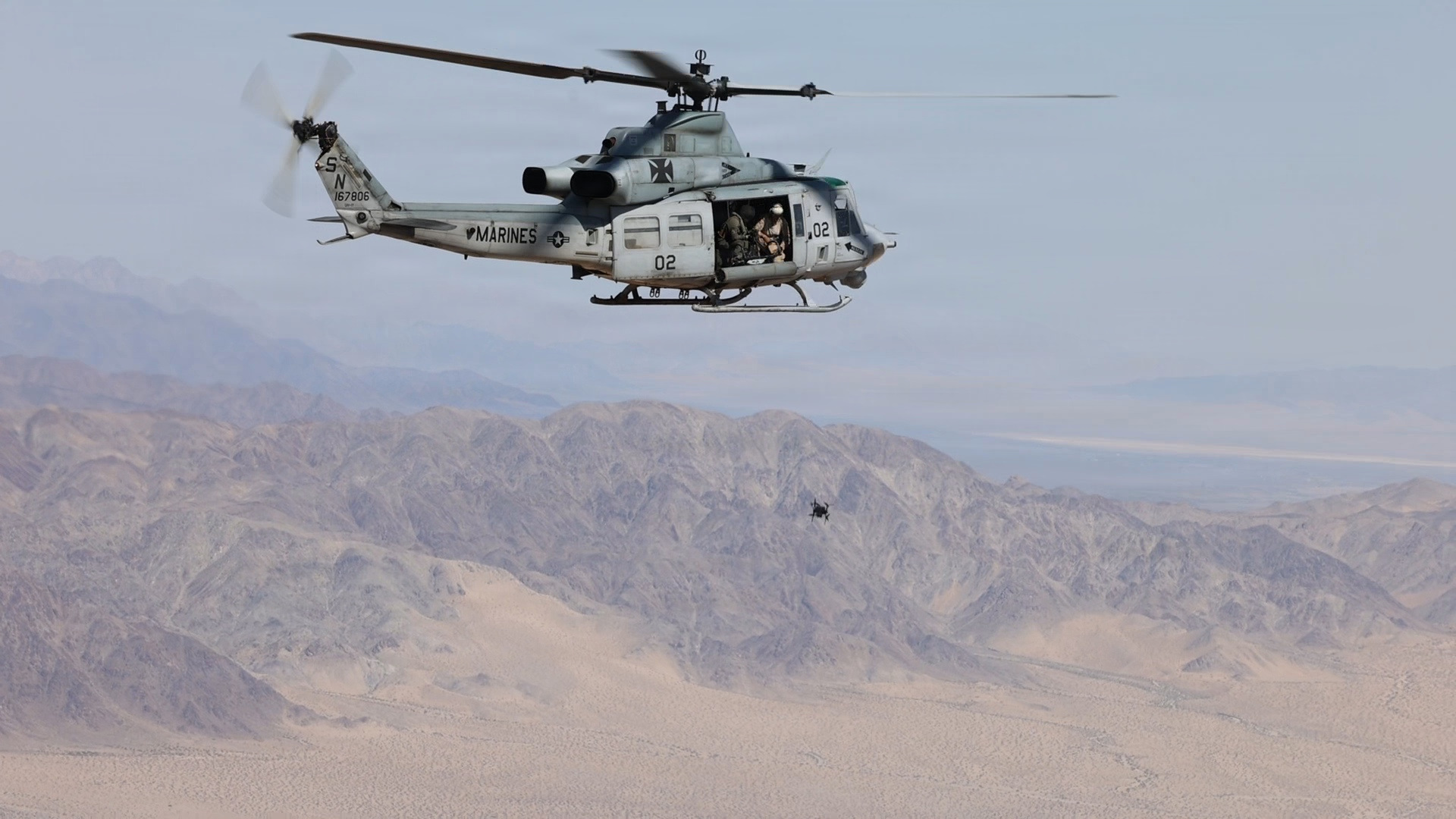
During the test, troops launched a Neros Archer FPV drone from the ground before transferring control to operators aboard a helicopter orbiting miles away.
The US Marine Corps is aggressively pursuing distributed lethality and battlefield awareness through advanced drone and autonomous systems integration, driven by evolving peer-to-peer threats.
This test demonstrates a significant step towards creating more resilient and adaptable command and control structures for drone swarms, enhancing battlefield autonomy and reducing reliance on fixed ground stations.
Control of drones can now be fluidly transferred between ground and airborne platforms, enabling greater operational flexibility and range of remote operations in complex environments.
- · Defence Tech Manufacturers
- · US Marine Corps
- · Developers of mobile C2 systems
- · Adversaries with traditional air defense strategies
- · Fixed ground-based C2 infrastructure
Increased operational flexibility and survivability for drone-based reconnaissance and strike missions.
Accelerated development of AI-driven autonomous swarming drone capabilities managed from mobile platforms.
Conversion of more manned aircraft into C2 nodes for distributed, autonomous warfare operations, reshaping air combat roles.
This signal links to a primary source. Continuum Brief monitors and indexes it as part of the live intelligence stream — we do not republish source content.
Read at C4ISRNET