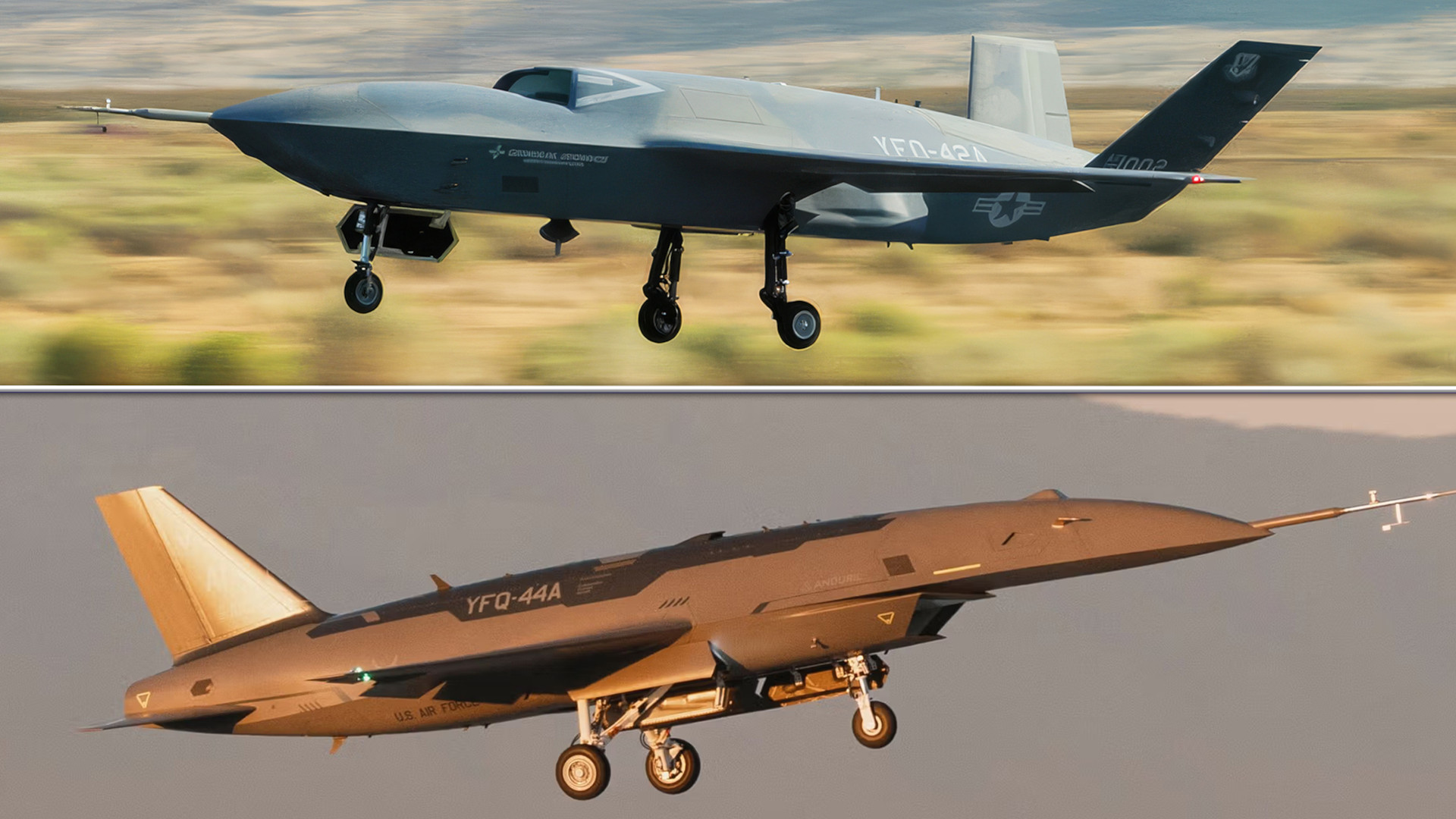
Buying both Collaborative Combat Aircraft designs instead of just selecting one has a number of big advantages to what is still a high-risk program. The post USAF Orders Both General Atomics’ FQ-42 And Anduril’s FQ-44 Into Production appeared first on The War Zone .
The US Air Force is accelerating its Collaborative Combat Aircraft program to rapidly field autonomous drone technologies in response to evolving geopolitical threats and a perceived need for increased force multiplier capabilities.
This move signifies a concrete commitment to distributed autonomous systems in air warfare, diversifying the industrial base and distributing risk across multiple vendors for a critical defense capability.
Instead of a single design, the USAF is pursuing a dual-track production strategy for CCAs, fostering competition and redundancy in a high-risk program, potentially accelerating deployment and robustness.
- · General Atomics
- · Anduril
- · US defense industrial base
- · US Air Force
- · Traditional prime contractors with single-solution offerings
- · Competitors not selected for dual production
The rapid development and deployment of autonomous combat aircraft will likely influence future air power doctrine and procurement strategies globally.
Increased competition and diversified production could accelerate innovation in AI, autonomy, and drone swarm capabilities within the defense sector.
The success of this dual-track approach might set a precedent for future high-risk defense programs, favoring multiple vendors and flexible acquisition strategies.
This signal links to a primary source. Continuum Brief monitors and indexes it as part of the live intelligence stream — we do not republish source content.
Read at The War Zone