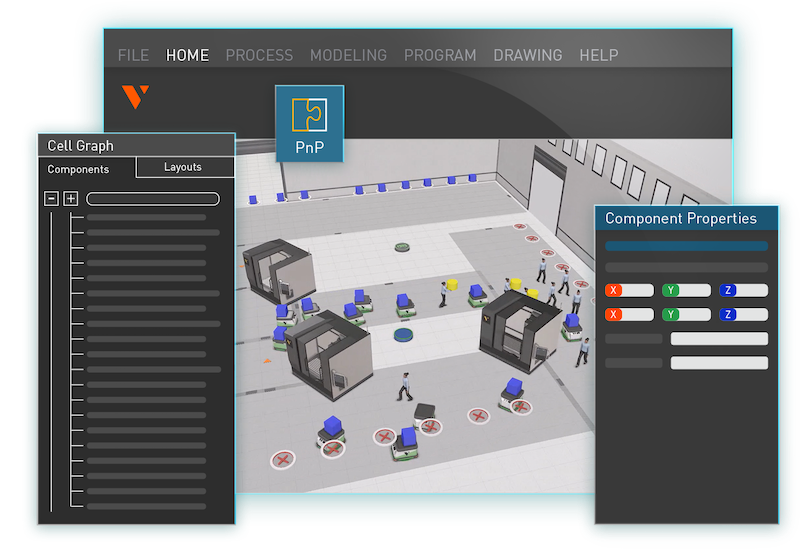
Visual Components, a specialist in 3D manufacturing simulation and robot offline programming, has announced the release of Visual Components 5.1, a major advancement in factory simulation designed to enable manufacturers to manage the growing complexity of autonomous production environments. The new release introduces highly accurate physics simulation and scalable robot orchestration capabilities, enabling manufacturers to […]
The increasing complexity of autonomous manufacturing and the drive towards Industry 4.0 demand more sophisticated simulation and orchestration tools for efficient development and deployment.
This development allows manufacturers to better design, test, and integrate advanced robotics and automation, accelerating the adoption of autonomous production environments and potentially reducing costs and risks.
The ability to conduct highly accurate physics simulation and scalable robot orchestration directly impacts the speed and fidelity of bringing new automated factory designs online.
- · Manufacturing companies
- · Automation software providers
- · Robot manufacturers
- · Systems integrators
- · Legacy manual manufacturing processes
- · Companies slow to adopt simulation technologies
Manufacturers can more quickly and reliably deploy complex autonomous systems, reducing development cycles and improving production efficiency.
This improved efficiency and reduced risk could accelerate the overall pace of industrial automation adoption across various sectors, leading to a more automated global manufacturing base.
The widespread adoption of highly simulated and orchestrated autonomous factories might redefine the competitive landscape, favoring nations and companies capable of integrating these advanced technologies at scale.
This signal links to a primary source. Continuum Brief monitors and indexes it as part of the live intelligence stream — we do not republish source content.
Read at Robotics & Automation News