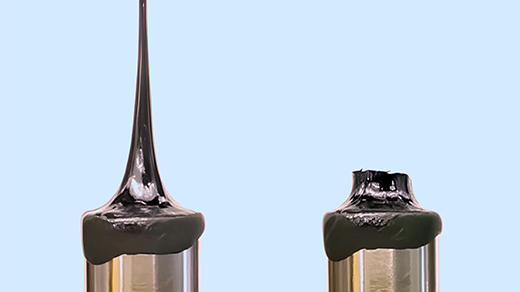
Researchers thought that what enabled complex fluids to break apart was their elasticity. But a crack in a nonelastic simple fluid has them questioning that idea. The post We Know Simple Fluids Can Flow. Turns Out, Some Can Fracture. first appeared on Quanta Magazine
New research has demonstrated an unexpected property in simple fluids, challenging long-held assumptions about material fracture mechanics. This discovery arises from ongoing fundamental scientific inquiry into material properties.
This finding fundamentally redefines our understanding of fluid mechanics, potentially opening new avenues for material science, design, and engineering applications. It challenges established scientific paradigms in fluid dynamics.
The previous understanding that only complex, elastic fluids could fracture is now questioned, implying that simpler, non-elastic fluids also possess this capacity under certain conditions. This expands the known behaviors of matter.
- · Material scientists
- · Engineers working with fluid dynamics
- · Researchers in rheology
- · Textbook definitions of fluid fracture
- · Assumptions based solely on elasticity for material failure
Fundamental theories of fluid mechanics are being re-evaluated to incorporate this new observation.
New materials or engineering processes could emerge that exploit or mitigate the fracture properties of simple fluids.
This could lead to breakthroughs in areas like microfluidics, lubrication, or even geophysical processes involving fluid flows.
This signal links to a primary source. Continuum Brief monitors and indexes it as part of the live intelligence stream — we do not republish source content.
Read at Quanta Magazine