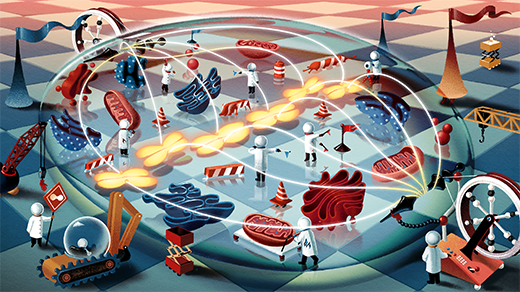
The mechanical process of cell division exerts powerful, if microscopic, forces. How do the molecular machines that power it manage the strain? The post What Breaks a Cell’s Ribs Can Make It Stronger first appeared on Quanta Magazine
This research reveals new insights into cellular mechanics, advancing our understanding of fundamental biological processes that are becoming increasingly relevant with new biotechnologies.
Understanding how cells manage mechanical stress during processes like division is crucial for synthetic biology and therapeutic applications, potentially leading to stronger, more resilient engineered biological systems.
Our mechanistic understanding of cellular integrity under stress improves, offering new design principles for manipulating or repairing biological systems.
- · Synthetic biology researchers
- · Biotechnology sector
- · Therapeutics development
Improved understanding of cell mechanics at a molecular level.
Development of enhanced techniques for cell engineering and manipulation.
New biomaterials or therapeutic approaches inspired by cellular stress-response systems.
This signal links to a primary source. Continuum Brief monitors and indexes it as part of the live intelligence stream — we do not republish source content.
Read at Quanta Magazine