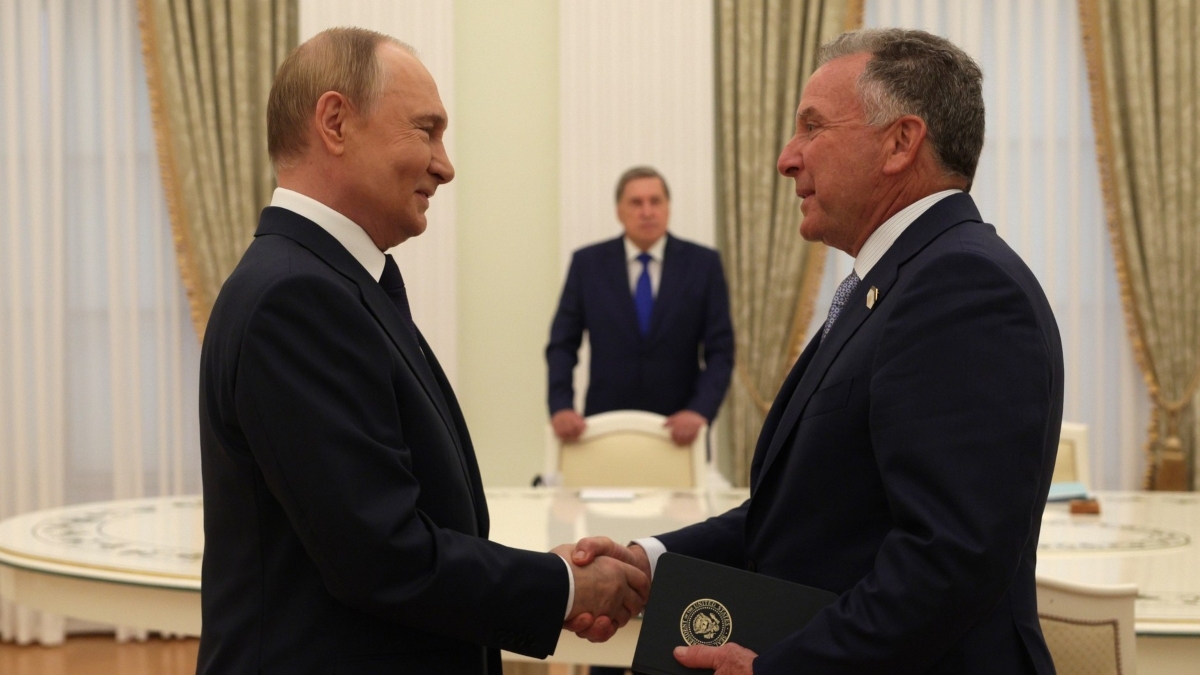
Rose Gottemoeller joined Ryan in Washington. They discussed how the West might think about relations with Russia once the war with Ukraine ends, as well as nuclear diplomacy and other critical issues. Gottemoeller was the deputy secretary general of NATO and, before that, served as a senior State Department official. She is currently at the Freeman Spogli Institute for International Studies at Stanford University and has a new book out called Security Through Cooperation: Space, Nuclear Weapons, and US-Russia Relations after the Cold War (Stanford University Press).Image: Kremlin.ru via Wikime
The discussion about post-war Russia is emerging now as the conflict in Ukraine introduces uncertainty and a need for strategic foresight regarding future international relations.
This dialogue is important for strategic readers as it shapes the long-term geopolitical landscape, particularly concerning European security, nuclear stability, and diplomatic frameworks.
The nature of relations with Russia post-conflict will be fundamentally reshaped, moving from direct confrontation to new forms of engagement, potentially altering existing alliances and diplomatic approaches.
- · Diplomatic institutions
- · NATO (redefined role)
- · European security frameworks
- · Russian hardliners
- · Military-first foreign policy advocates
The immediate effect is a proactive strategic planning for complex post-conflict scenarios with Russia.
A plausible second-order consequence is the re-evaluation of security architectures in Europe and potential shifts in global power dynamics.
A speculative third-order consequence could be the emergence of new, unconventional alliances or security blocs necessitated by a changed Russian state.
This signal links to a primary source. Continuum Brief monitors and indexes it as part of the live intelligence stream — we do not republish source content.
Read at War on the Rocks