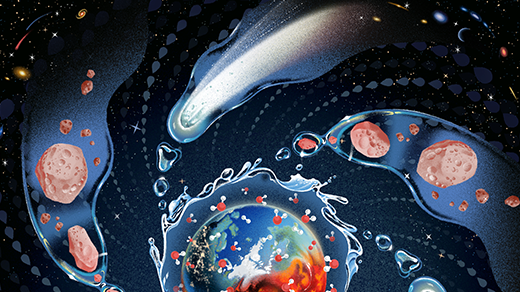
At first, scientists thought Earth’s water came from comets. Then, asteroids. Now, they wonder if Earth’s water is homegrown. The post Where Did Earth Get Its Oceans? Maybe It Made Them Itself. first appeared on Quanta Magazine
Scientific inquiry continuously refines our understanding of planetary formation and astrobiology, driven by new observational data and modeling techniques.
Understanding the origin of Earth's water profoundly impacts our search for extraterrestrial life, habitability models for exoplanets, and the definition of essential planetary conditions.
The primary hypothesis for Earth's water origin potentially shifts from external delivery (comets, asteroids) to internal geological processes, indicating a more intrinsic water formation mechanism.
- · Planetary geologists
- · Astrobiologists
- · Planetary science research institutions
- · Researchers exclusively focused on exogenous water delivery
Further research funding may be directed towards geological processes for water generation on rocky planets.
Models for exoplanet habitability might be revised to emphasize internal planetary processes over purely external bombardment for water acquisition.
The perceived rarity of water in the universe could decrease if internal origins are more common than previously thought, influencing space exploration strategies.
This signal links to a primary source. Continuum Brief monitors and indexes it as part of the live intelligence stream — we do not republish source content.
Read at Quanta Magazine