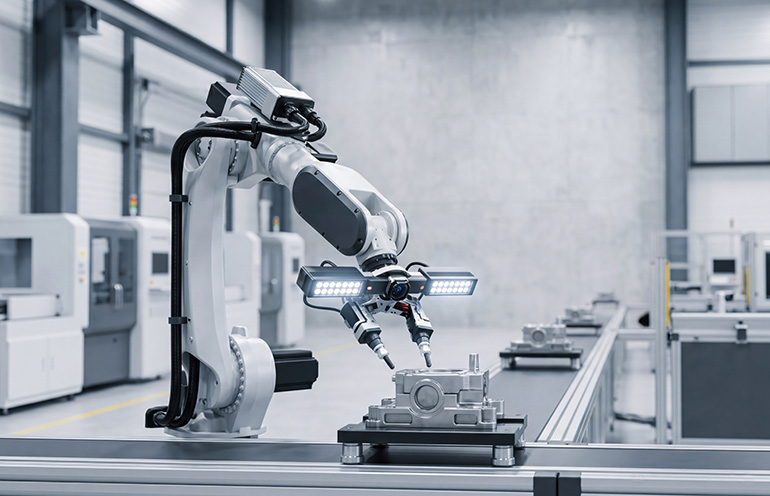
While vision and language are key parts of physical AI, physical state recovery will enable robots to interact with the world, says a columnist. The post Why physical AI 2.0 needs a reality check appeared first on The Robot Report .
The increased public discussion around physical AI highlights a growing recognition of the gap between current academic advancements and the practical requirements for real-world robot interaction.
Achieving robust physical state recovery is critical for commercializing useful humanoid and general-purpose robots, moving beyond controlled environments to dynamic, unstructured settings.
The focus of AI development in robotics may shift more decisively towards embodied intelligence and sensorimotor learning, rather than solely on large language models and cognitive architectures.
- · Robotics companies focused on physical interaction
- · Sensor manufacturers
- · AI researchers in embodied cognition
- · Logistics and manufacturing sectors
- · Companies relying solely on cloud-based AI for robotics
- · Investors expecting immediate, frictionless physical AI deployment
Increased investment and research into physical state recovery and tactile sensing for robots.
Faster development and deployment of physically capable humanoid and autonomous robots in various industries.
The acceleration of human-robot co-existence in diverse environments, leading to new societal and economic structures.
This signal links to a primary source. Continuum Brief monitors and indexes it as part of the live intelligence stream — we do not republish source content.
Read at The Robot Report