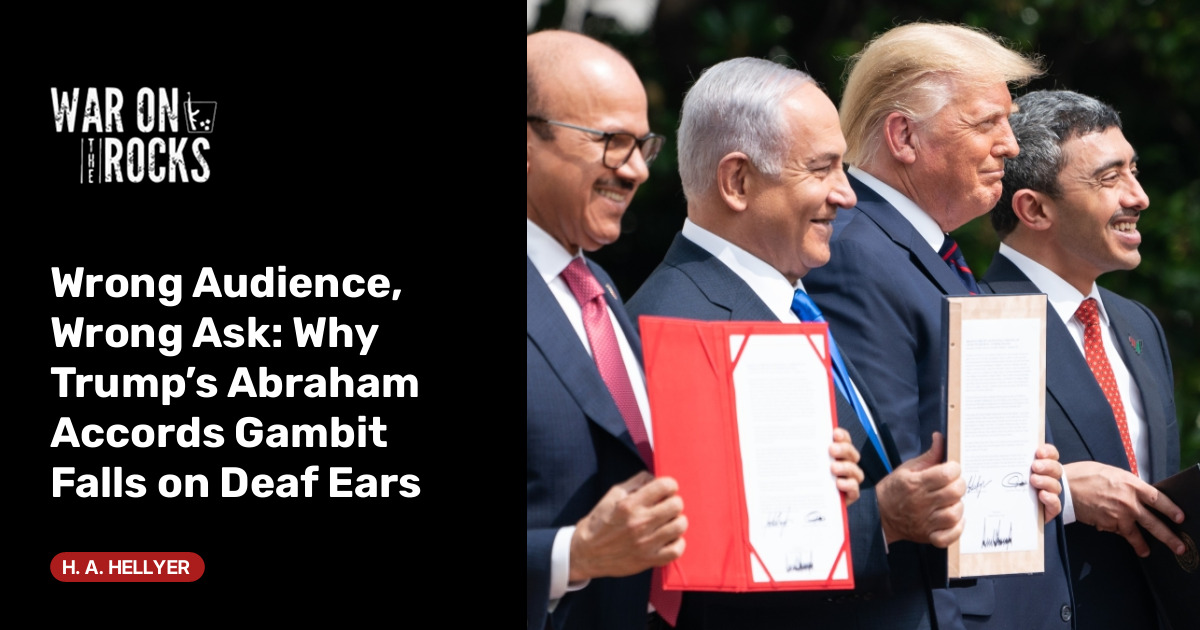
When President Donald Trump repeatedly pressed regional leaders on Abraham Accords expansion late last month — framing Arab-Israeli normalization as a debt owed and a condition for a settlement to end the Iran war — he apparently commented there had been silence on the other end of the line.Arab and Muslim states are not silent because they lack a position on normalization. Indeed, collectively they have already articulated one through the Arab Peace Initiative — the 2002 proposal that offered normalized relations between Israel and over 50 countries. In exchange, it required Israel to fully
The Trump administration's continued push for Abraham Accords expansion highlights ongoing efforts to reshape Middle East diplomatic relations, particularly concerning the Israel-Palestine conflict and Iran.
This event underscores the persistent diplomatic chasm between the US approach to Middle East peace and the established position of Arab states, revealing a fundamental misunderstanding or disregard of their collective demands for a resolution to the Israeli-Palestinian issue.
It clarifies that normalization efforts, particularly those framed without addressing the Palestinian question, continue to face significant resistance from Arab and Muslim states, limiting the potential for broad, sustained regional peace initiatives without a shift in core demands.
- · Iran (as a regional strategic focus)
- · Palestinian Authority (maintaining leverage on normalization)
- · US diplomatic challengers
- · Abraham Accords expansion proponents
- · US influence without concessions
- · Regional stability without a comprehensive approach
Arab and Muslim states continue to reject normalization without a resolution to the Israeli-Palestinian conflict.
This rejection could lead to increased regional tensions or a strengthened anti-normalization bloc if pressured further.
Future US administrations may need to significantly rethink their Middle East peace strategies to achieve broader regional buy-in, potentially involving a more comprehensive approach to the Israeli-Palestinian issue.
This signal links to a primary source. Continuum Brief monitors and indexes it as part of the live intelligence stream — we do not republish source content.
Read at War on the Rocks