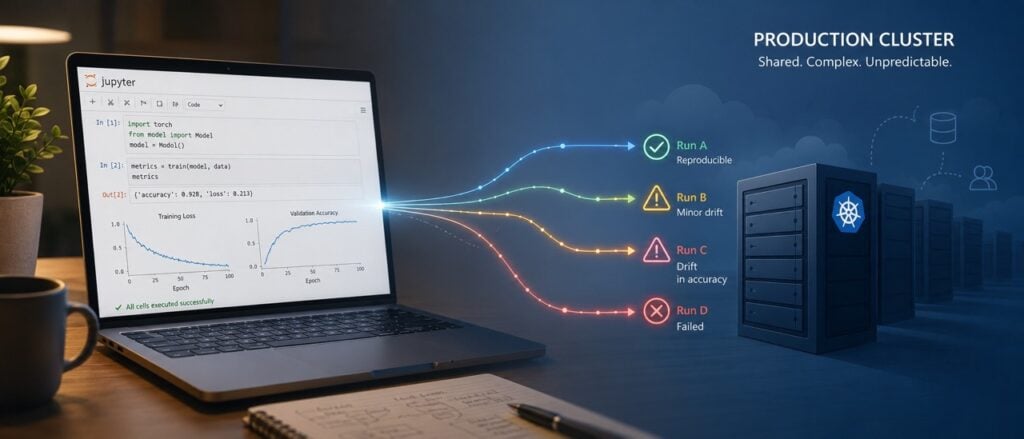
A model working in a notebook gives you a particular kind of confidence. The metrics look good, the code runs top to bottom, the researcher demos it, leadership nods, and everyone agrees it’s ready to scale. Then it hits the cluster, and it starts coming apart. Here’s the part nobody The post Your Model Works in the Notebook and Breaks in the Cluster appeared first on Cloud Native Now .
The proliferation of AI models, particularly large ones, is exposing critical bottlenecks and challenges in their deployment from development environments to production clusters.
This issue highlights significant practical hurdles in scaling AI infrastructure, impacting the efficiency and cost-effectiveness of AI development and deployment for organizations.
The focus is shifting from pure model development to robust MLOps, container orchestration, and GPU infrastructure management, changing how AI projects are assessed and delivered.
- · Container/Kubernetes management platforms
- · MLOps platforms
- · Cloud infrastructure providers
- · AI infrastructure solution providers
- · Organizations with immature AI deployment practices
- · Developers focused solely on model training
- · Generic cloud compute providers lacking specialized AI tooling
Increased investment in MLOps tools and expertise to bridge the gap between AI model development and production.
Greater demand for skilled professionals in containerization, Kubernetes, and GPU orchestration, leading to upskilling initiatives.
A potential slowdown in the pace of AI integration into critical enterprise systems if deployment challenges are not effectively addressed, impacting overall AI adoption.
This signal links to a primary source. Continuum Brief monitors and indexes it as part of the live intelligence stream — we do not republish source content.
Read at Container Journal